John Charet’s Top 10 Favorite Film Noirs of All Time

-A Few Words Before Reading-

Please be kind to the film at number 01 on this list because that one means a lot to me. Any comment expressing negativity towards number 01 will be deleted. So once again, please be polite ðŸ™‚

-Introduction-

Why am I first deciding to concoct a list of my top 10 favorite film noirs of all time to close out November? Simple. Throughout the entire month, November is more or less dedicated towards film noirs. Hence the word Noirvember, a monthly long holiday dedicated towards film noirs that originated in 2010 by great female film critic Marya E. Gates (read here). So now in it’s fourteenth year, I decided to compile a list of ten titles that I consider to be some of the greatest ever made. There were choices that I wish I could have included, but that would take a lot longer because I have tons of favorite noirs. Now I limited the list to film noirs alone as opposed to neo noir and tech noir. The reason for this is because traditional noir (film noir in this case) came first and I felt that it only made sense to focus solely on that. One of these days though, I will provide another list dedicated towards neo, tech and proto noirs, which came before film noir. Also, click here to listen to some fitting music for the mood If you readers want 🙂 Now without further ado, I present to you all:

-My Top 10 Favorite Film Noirs of All Time-
(#10-01)

10.) The Narrow Margin (1952)
Dir: Richard Fleischer
Country: United States
Color: Black and White

When it comes to 1950’s film noirs, The Narrow Margin stands out as quite possibly the most inventive of them all. Along with Alfred Hitchcock’s 1938 British mystery classic The Lady Vanishes, The Narrow Margin ranks as the quintessential train thriller. Like that aforementioned earlier film, The Narrow Margin is set almost entirely on a train. As directed by the frequently reliable, not to mention unfairly overlooked, Richard Fleischer, The Narrow Margin is an assured piece of genre filmmaking. Throughout it’s slim 72-minute running time, The Narrow Margin remains a taut B Noir full of twists, turns and clever dialogue.

Click here to watch a youtube video link to TCM’s (Turner Classic Movies) Eddie Muller’s intro to the film from his Noir Alley series

Click here to watch a youtube video link to TCM’s (Turner Classic Movies) Eddie Muller’s outro to the film from his Noir Alley series

Click here to watch a youtube video link to the film’s original theatrical trailer

09.) They Live by Night (1948)
Dir: Nicholas Ray
Country: United States
Color: Black and White

Nicholas Ray’s 1948 directorial debut is also the film that cemented his reputation as the poetic outsider of Classical Hollywood cinema. Stylistically, Ray would go on to make bolder films, but his personal themes have never been presented more assuredly than in They Live by Night. As with most of Ray’s films, They Live by Night examines the contrast between it’s anti-hero and the environment surrounding them. Adapted from Edward Anderson’s 1937 Depression-era novel Thieves Like Us, They Live By Night centers on an escaped convict’s struggle to break free from his criminal past. As usual, Ray’s expressive mise-en-scene blends perfectly with the film’s melodrama. No other film noir is simultaneously electrifying and poignant as They Live by Night.

Click here to watch a youtube video link to TCM’s (Turner Classic Movies) Eddie Muller’s intro to the film from his Noir Alley series

Click here to watch a youtube video link to TCM’s (Turner Classic Movies) Eddie Muller’s outro to the film

Click here to watch a youtube video link to the entire film

I can’t really find a proper trailer for the film

08.) The Killing (1956)
Dir: Stanley Kubrick
Country: United States
Color: Black and White

If Fear and Desire and Killer’s Kiss resembled the work of a talented beginner, than The Killing resembles that of a master filmmaker. Director Stanley Kubrick’s breakthrough third feature is also the most tightly constructed of his films. Not unlike John Huston’s The Asphalt Jungle, The Killing centers on the planning, execution and aftermath of a robbery that goes awry. Only here, Kubrick presents this film noir’s narrative in a nonlinear fashion and as a storytelling device, it served as an influence on Quentin Tarantino when he made his 1992 directorial debut Reservoir Dogs. All in all, The Killing may just be the greatest heist film ever made.

Click here to watch a youtube video link to TCM’s (Turner Classic Movies) Eddie Muller’s intro to the film from his Noir Alley series

Click here to watch a youtube video link to TCM’s (Turner Classic Movies) Eddie Muller’s outro to the film from his Noir Alley series

Click here to watch a youtube video link to the film’s original theatrical trailer

07.) Murder by Contract (1958)
Dir: Irving Lerner
Country: United States
Color: Black and White

Cited by master filmmaker Martin Scorsese as the film that has influenced him the most, Murder by Contract also happens to be my number one favorite B Noir of all-time. For me, Murder by Contract remains every bit as fresh today as it was during it’s initial theatrical release back in 1958. Lucien Ballard’s black and white cinematography and Perry Botkin’s minimalistic guitar score fit perfectly with the film’s deadpan tone and it’s existentialist anti-hero. If anything else, Murder by Contract is debatably the closest thing the American cinema will ever get in giving us a Bressonian film noir, albeit one with a dry sense of humor. I do not know about the rest of director Irving Lerner’s output, but the fact that he made the extraordinary Murder by Contract is an achievement in itself.

Click here to watch a youtube video link to TCM’s (Turner Classic Movies) Eddie Muller’s intro to the film from his Noir Alley series

Click here to watch a youtube video link to TCM’s (Turner Classic Movies) Eddie Muller’s outro to the film from his Noir Alley series

Click here to watch a youtube video link to the entire film

Click here to watch another youtube video link to the entire film

Click here to watch a youtube video link to the film’s original theatrical trailer

06.) Angel Face (1952)
Dir: Otto Preminger
Country: United States
Color: Black and White

If I were to program a double bill of two Otto Preminger films that consisted of a literary adaptation and a film noir, I would choose Bonjour Tristesse for the former and Angel Face for the latter. The great former Chicago Reader film critic Jonathan Rosenbaum could not have stated it any better when he said that in some ways, Angel Face is Preminger’s first draft of his 1958 Bonjour Tristesse. The similarity is that both films center on a spoiled, wealthy and ultimately destructive young female. As the conniving Diane Tremayne, Jean Simmons creates one of the most interesting cinematic femme fatales ever. As with lead actor Robert Mitchum, Simmons is simultaneously charismatic and sexy. Effortlessly blending film noir with melodrama, Angel Face (like Bonjour Tristesse after it) emerges as the purest expression of Preminger’s mise-en-scene with an audacious ending to boot.

Click here to watch a youtube video link to TCM’s (Turner Classic Movies) Eddie Muller’s intro of the film from his Noir Alley series

Click here to watch a youtube video link to TCM’s (Turner Classic Movies) Eddie’s Muller’s outro to the film from his Noir Alley series

Click here to read former Chicago Reader film critic Jonathan Rosenbaum’s article on film noirs in which he talks about Angel Face. The title of the article is Ten Overlooked Noirs.

Click here to watch a youtube video link to the film’s original theatrical trailer

05.) The Shanghai Gesture (1941)
Dir: Josef von Sternberg
Country: United States
Color: Black and White

Even after meeting all of the demands imposed on it by the Hays Office for a seal of approval, The Shanghai Gesture still emerges as a sensual cinematic work of art. As directed by the great Josef von Sternberg, The Shanghai Gesture is an inspired marriage between form and content. Since it was inevitably going to be adapted as a toned down version of John Colton’s provocative 1926 Broadway play of the same name, the Austrian-American Sternberg ended up doing the next best thing. Sternberg’s reliance on Boris Leven’s stylized art direction and Oleg Cassini’s sexy and stylish costume designs go a long way in shaping The Shanghai Gesture’s mise-en-scene as one of decadence, which is represented here by a casino (in Colton’s play, it was a brothel). If anything else, as a film noir, The Shanghai Gesture is the crowning achievement of visual style.

Click here to watch a youtube video link to an essay on the film from a channel on the site called One Way Ticket Productions

Click here to watch a youtube video link to the entire film

Click here to watch another youtube video link to the entire film

I could not a link the film’s original theatrical trailer

04.) The Lady from Shanghai (1947)
Dir: Orson Welles
Country: United States
Color: Black and White

With the exception of Edgar G. Ulmer’s Detour, no other film noir has benefited as tremendously from it’s shortcomings as The Lady from Shanghai. Director Orson Welles original cut of The Lady from Shanghai reportedly ran 155 minutes, but Harry Cohn (then head of Columbia Pictures) despised it and recut the film (read here). Not unlike the similarly truncated The Magnificent Ambersons, The Lady from Shanghai was coincidentally released in an 88-minute cut and remains the only existing version of the film as of 2024. Even so, when one takes into account film noir’s emphasis on twists and turns (i.e. The Big Sleep), a credible argument can be made that The Lady from Shanghai works as an elaborate spoof of the aforementioned subgenre. As instructed by Welles, Rita Hayworth cut her long natural red hair short and bleached it blonde to play the femme fatale of the title much to Cohn’s dismay (read here). Along with Lana Turner in The Postman Always Rings Twice, the always sexy Hayworth creates one of the sexiest cinematic blonde femme fatales ever with her portrayal of Elsa “Rosalie” Bannister. Last, but not least, The Lady from Shanghai is noted for it’s dazzling climactic sequence set in a House of mirrors that has been referenced in everything from Enter the Dragon to John Wick: Chapter 2 and beyond.

Click here to watch a youtube video link to TCM’s (Turner Classic Movies) Eddile Muller’s intro to the film from his Noir Alley series

Click here to watch a youtube video link to TCM’s (Turner Classic Movies) Eddie Muller’s outro to the film from his Noir Alley series

Click here to watch a youtube video link of Mueller and Alicia Malone discussing the film and it’s lead actress Rita Hayworth from TCM (Turner Classic Movies) a few years back

Click here to watch a youtube video link to the film’s original theatrical trailer

03.) The Night of the Hunter (1955)
Dir: Charles Laughton
Country: United States
Color: Black and White

Indifferently received by both critics and audiences during it’s initial theatrical release back in 1955, The Night of the Hunter has since been reassessed (and deservedly so) as one of the greatest directorial debuts in cinematic history. Unfortunately, the film’s then polarizing reception reportedly disillusioned actor Charles Laughton so much that he decided to never direct another film again. A shame because The Night of the Hunter resembles the work of a cinematic giant. German Expressionism has influenced film noir in a number of ways, but never more deeply than in The Night of the Hunter. Stanley Cortez stylized black and white cinematography gives The Night of the Hunter a dreamlike vibe that harkens back to the films of the Silent era. As conman/serial killer Harry Powell, Robert Mitchum creates one of the screen’s most unforgettable villains. Behind Powell’s charming phony preacher persona lies a man of unadulterated evil. With the exception of Cape Fear, Mitchum has never been more menacing than he is here. Referenced in everything from The Rocky Horror Picture Show to Do the Right Thing to more recently, Promising Young Woman, The Night of the Hunter has also influenced the work of directors as diverse as Rainer Werner Fassbinder, Joel and Ethan Coen and Guillermo del Toro to name just a few.

Click here to watch a youtube video link featuring directors William Friedkin and Spike Lee and horror icon Robert Englund’s appreciation of the film

Click here to watch a youtube video link of Guillermo del Toro’s appreciation of the film

Click here to watch a youtube video link of the film’s original theatrical trailer

02.) Leave Her to Heaven (1945)
Dir: John M. Stahl
Country: United States
Color: Color

Extraordinary on every single level imaginable, Leave Her to Heaven also happens to be my number one favorite film noir of the 1940’s. As the first film noir shot in color (read here), Leave Her to Heaven is noted for uniquely blending elements belonging to that aforementioned subgenre with that of melodramas, romantic dramas and psychological thrillers. The result still stands out today as an American masterpiece in a class of it’s own. Though he made two other very excellent films that Douglas Sirk would later not only equal, but surpass (Magnificent Obsession and Imitation of Life), Leave Her to Heaven towers above them all as director John M. Stahl’s greatest film. Leon Shamroy’s gorgeous Technicolor cinematography and Kay Nelson’s stylish costume designs serve as only two of many aspects that shape Stahl’s dazzling mise-en-scene. For my money, the always sexy Gene Tierney delivers a performance for the ages as the cold-hearted and narcissistic Ellen Berent Harland, who simultaneously ranks as the sexiest and most complex femme fatale in cinematic history. Aside from ranking as the second highest grossing film of 1945 after The Bells of St. Mary’s, Leave Her to Heaven also reportedly ranked as 20th Century Studios (then 20th Century Fox) biggest box-office hit of the decade. Now that is something.

Click here to watch a youtube video link to TCM’s (Turner Classic Movies) Alicia Malone’s intro and outro to the film from a few years back

Click here to watch a youtube video link to master filmmaker Martin Scorsese’s introduction of the film at the 2007 New York Film Festival

Click here to watch a youtube video link to Scorsese introducing it again. Only this time it was from this year in 2024. The date he introduced it was on Sunday, November 10, 2024

Click here to watch a youtube video link to the entire film

Click here to watch another youtube video link to the entire film

Click here to watch a youtube video link to the film’s original theatrical trailer

Click here to watch another youtube video link to the film’s original theatrical trailer

Click here to watch another youtube video link to the film’s original theatrical trailer

01.) Vertigo (1958)
Dir: Alfred Hitchcock
Country: United States
Color: Color

The other great former Chicago Reader film critic Dave Kehr eloquently praised Vertigo as One of the landmarks-not merely of the movies, but of 20th-century art. I am in total agreement with him. Coincidentally, Vertigo simultaneously ranks as my number one favorite film noir and film of all time (read here, here, here and here). For me, Vertigo not only stands out as the crowning achievement of Classical Hollywood cinema, but of filmmaking on a whole. No other cinematic masterwork has impacted me on so many levels than this 1958 American classic. Set to celebrated composer Bernard Herrmann’s unforgettable music score, Vertigo opens with a characteristically expressive title sequence designed by the legendary Saul Bass. After this, we are treated to one of the most atmospheric and visually stunning films ever made. In the center, Vertigo is two beautifully realized films for the price of one. What begins as a riveting mystery, suddenly turns into a haunting drama of sexual obsession. The result is every bit as erotic as it is disturbing and ultimately tragic. As directed by the iconic Alfred Hitchcock (a.k.a. The Master of Suspense), Vertigo is a masterpiece of form and content. More than that, Vertigo serves as Hitchcock’s magnum opus. Though renowned (and justifiably so) as a showman, Hitchcock also deserves to be lauded as an artist. This latter trait has never been more evident than in Vertigo. In that same review, Kehr summed up Vertigo as the most intensely personal movie to emerge from the Hollywood cinema. Kehr is totally right on that. For everybody involved, Vertigo represents the pinnacle of their careers. What else left is there for me to say except that Vertigo is (for myself) the greatest film ever made.

Click here to read former Chicago Reader film critic Dave Kehr’s review of Vertigo

Click here to view the film’s original theatrical trailer

Click here to view the film’s 1996 Restoration trailer

Click here to view the film’s 60th anniversary 4K Restoration trailer

Click here to view legendary title designer Saul Bass masterful opening title sequence

Click here to view the film’s memorable psychedelic dream sequence

Click here to listen to Bernard Herrmann’s haunting music for the film

Click here to view the documentary on Vertigo’s 1996 Restoration from 1997 entitled Obsessed with Vertigo

Let me conclude this blog entry with two questions for my dear readers below:

What are your top 10 favorite film noirs of all time? (not proto, neo or tech)

What links (video or otherwise) interested you the most?

John Charet’s Top 100 Favorite Horror Films of All-Time

-Introduction-

Last year around this time of year, I posted a blog entry regarding my Top 10 Favorite Horror Films of All-Time. As all of my dear readers are probably aware, I posted this year’s entry one week before Halloween (click here). As for Halloween 2024, I have posted a big treat, which comes in the form of my Top 100 Favorite Horror Films of All-Time. Now all of the films listed are not my only favorite horror films (I have an unlimited number), but this is a perfect start. I have decided to start with number 100 and work my way down to 01.

-The Opening Celebration-

First off, below are a few delightful links to check out 🙂

Click here to watch the complete 1983 music video of late iconic singer Michael Jackson’s (a.k.a. The King of Pop) song Thriller

Click here to listen to a shortened version of the song

Have any of you dear readers out there heard of The Merkins? Check out their youtube channel here. They do horror parodies of songs and one of their running acts is The Slashstreet Boys (a spoof of The Backstreet Boys) 🙂 The band consists of Leatherface, Michael Myers, Jason Voorhees, Freddy Kruegger and Ghostface 🙂 Below are three of my personal favorite parodies of theirs 🙂

Click here to view their spoof of I Want It That Way entitled I’ll Kill You That Way

Click here to view their spoof of Larger than Life entitled Die By My Knife

Click here to view their spoof of Rock Your Body Right entitled Slashing Bodies

-A Few Words Before Reading-

Please be kind to the film at number 07 on this list because that one means a lot to me. Any comment expressing negativity towards number 07 will be deleted. So once again, please be polite 🙂

Now, without further ado, I present to you all:

-John Charet’t Top 100 Favorite Horror Films of All-Time-
(#100-01)

100.) The Lighthouse (2019) (Dir: Robert Eggers)
99.) Frankenstein (1931) (Dir: James Whale)
98.) The Spiral Staircase (1946) (Dir: Robert Siodmak)
97.) What Ever Happened to Baby Jane? (1962) (Dir: Robert Aldrich)
96.) Kwaidan (1964) (Dir: Masaki Kobayashi)

95.) The Exorcist (1973) (Dir: William Friedkin)
94.) The Changeling (1980) (Dir: Peter Medak)
93.) Bram Stoker’s Dracula (1992) (Dir: Francis Ford Coppola)
92.) The Orphanage (2007) (Dir: J.A. Bayona)
91.) Under the Shadow (2016) (Dir: Babak Anvari)
90.) The Invisible Man (1933) (Dir: James Whale)
89.) The Body Snatcher (1945) (Dir: Robert Wise)
88.) Kuroneko (1968) (Dir: Kaneto Shindo)
87.) Rosemary’s Baby (1968) (Dir: Roman Polanski)
86.) The Texas Chain Saw Massacre (1974) (Dir: Tobe Hooper)
85.) God Told Me To (1976) (Dir: Larry Cohen)
84.) The Entity (1982) (Dir: Sidney J. Furie)
83.) Jacob’s Ladder (1990) (Dir: Adrian Lyne)
82.) Halloween II (2009) (Dir: Rob Zombie)
81.) Annihilation (2018) (Dir: Alex Garland)
80.) The Texas Chainsaw Massacre 2 (1986) (Dir: Tobe Hooper)
79.) Twixt (2011) (Dir: Francis Ford Coppola)
78.) Bluebeard (1944) (Dir: Edgar G. Ulmer)
77.) Horror of Dracula (1958) (Dir: Terence Fisher)
76.) Island of Lost Souls (1932) (Dir: Erle C. Kenton)
75.) Onibaba (1964) (Dir: Kaneto Shindo)
74.) Night of the Living Dead (1968) (Dir: George A. Romero)
73.) Halloween (1978) (Dir: John Carpenter)
72.) Dead Alive (1992) (Dir: Peter Jackson)
71.) The Descent (2005) (Dir: Neil Marshall)
70.) The Lords of Salem (2012) (Dir: Rob Zombie)

69.) Dr. Jekyll and Mr. Hyde (1931) (Dir: Rouben Mamoulian)
68.) The Leopard Man (1943) (Dir: Jacques Tourneur)

67.) Frankenstein Must Be Destroyed (1969) (Dir: Terence Fisher)
66.) Blood and Black Lace (1964) (Dir: Mario Bava)
65.) The Tenant (1976) (Dir: Roman Polanski)
64.) Inferno (1980) (Dir: Dario Argento)
63.) Henry: Portrait of a Serial Killer (1986) (Dir: John McNaughton)
62.) Cemetery Man (1994) (Dir: Michele Soavi)
61.) Shaun of the Dead (2004) (Dir: Edgar Wright)
60.) The Phantom Carriage (1921) (Dir: Victor Sjostrom)
59.) Cat People (1942) (Dir: Jacques Tourneur)
58.) Psycho (1960) (Dir: Alfred Hitchcock)
57.) Kill, Baby… Kill! (1966) (Dir: Mario Bava)
56.) Suspiria (1977) (Dir: Dario Argento)
55.) Possession (1981) (Dir: Andrzej Zuwalski)
54.) The Fly (1986) (Dir: David Cronenberg)
53.) Cronos (1992) (Dir: Guillermo del Toro)
52.) Let the Right One In (2008) (Dir: Tomas Alfredson)
51.) The Babadook (2014) (Dir: Jennifer Kent)
50.) Nope (2022) (Dir: Jordan Peele)
49.) Haxan (1922) (Dir: Benjamin Christensen)
48.) The Old Dark House (1932) (Dir: James Whale)
47.) I Walked with a Zombie (1943) (Dir: Jacques Tourneur)
46.) The Birds (1963) (Dir: Alfred Hitchcock)
45.) Dawn of the Dead (1978) (Dir: George A. Romero)
44.) Evil Dead II (1987) (Dir: Sam Raimi)
43.) Cure (1997) (Dir: Kiyoshi Kurosawa)
42.) Martyrs (2008) (Dir: Pascal Laughier)
41.) The Haunting of Hill House (2018) (Dir: Mike Flanagan)
(Miniseries)
(Streaming/Television)
40.) Pearl (2022) (Dir: Ti West)

39.) The Fall of the House of Usher (1928) (Dir: Jean Epstein)
38.) Freaks (1932) (Dir: Tod Browning)
37.) Dead of Night (1945) (Dir: Alberto Cavalcanti, Charles Crichton, Basil Dearden and Robert Hamer)
(Anthology Film)
36.) The Innocents (1961) (Dir: Jack Clayton)
35.) The Wicker Man (1973) (Dir: Robin Hardy)
34.) Dead Ringers (1988) (Dir: David Cronenberg)
33.) Ringu (1998) (Dir: Hideo Nakata)
32.) Rec (2007) (Dir: Jaume Balaguero and Paco Plaza)
31.) Under the Skin (2013) (Dir: Jonathan Glazer)
30.) The Cabinet of Dr. Caligari (1920) (Dir: Robert Wiene)
29.) Bride of Frankenstein (1935) (Dir: James Whale)
28.) The Uninvited (1944) (Dir: Lewis Allen)
27.) Night of the Demon (1957) (Dir: Jacques Tourneur)
26.) The Haunting (1963) (Dir: Robert Wise)
25.) Eraserhead (1977) (Dir: David Lynch)
24.) The Thing (1982) (Dir: John Carpenter)
23.) Audition (1999) (Dir: Takashi Miike)
22.) Inside (2007) (Dir: Julien Maury and Alexandre Bustillo)
21.) Mother! (2017) (Dir: Darren Aronofsky)
20.) Un Chien Andalou (1929) (Dir: Luis Bunuel)
(Short Cinema)
19.) The Black Cat (1934) (Dir: Edgar G. Ulmer)
18.) Isle of the Dead (1945) (Dir: Mark Robson)
17.) Peeping Tom (1960) (Dir: Michael Powell)
16.) Hour of the Wolf (1968) (Dir: Ingmar Bergman)
15.) Let’s Scare Jessica to Death (1971) (Dir: John Hancock)
14.) Videodrome (1983) (Dir: David Cronenberg)
13.) The Kingdom Trilogy (1994/1997/2022) (Dir: Lars Von Trier)
(Danish Television)

12.) Pulse (2001) (Dir: Kiyoshi Kurosawa)
11.) Climax (2018) (Dir: Gaspar Noe)
10.) Vampyr (1932) (Dir: Carl Theodor Dreyer)
09.) The Shining (1980) (Dir: Stanley Kubrick)
08.) Nosferatu (1922) (Dir: F.W. Murnau)
07.) Twin Peaks: Fire Walk with Me (1992) (Dir: David Lynch)
06.) The Devil’s Backbone (2001) (Dir: Guillermo del Toro)
05.) Midsommar (2019) (Dir: Ari Aster)
04.) The Seventh Victim (1943) (Dir: Mark Robson)
03.) Diabolique (1955) (Dir: Henri-Georges Clouzot)
02.) Eyes Without a Face (1960) (Dir: Georges Franju)
01.) Don’t Look Now (1973) (Dir: Nicolas Roeg)

P.S. I just added two links from this year’s blog entry regarding my Top 10 Favorite Horror Films of All-Time – a Kim Newman commentary link on number 3 and a documentary link on number 4. Click here 🙂

Anyway, I hope all of you enjoyed reading my Top 100 Favorite Horror Films of All-Time list and last, but not least:

Have a Happy Halloween
. .
U

John Charet’s Official Top 10 Favorite Horror Films of All-Time

Note: Next Thursday, which is October 31st (Halloween), I will be posting a blog entry regarding my Top 100 Favorite Horror Films of All Time, so this is not the only Halloween post I will be doing this year 🙂

This blog entry is dedicated to what I consider to be an official version of my Top 10 Favorite Horror Films of All-Time. Aside from some different choices (see numbers 4,5 and 6) this year, every film on here from last years remains intact. I know I have said it before, but it bears repeating – all lists (including my own) are subjective. Nevertheless, please be kind to number 7 on this list because that one means a lot to me, so once again please be polite 🙂 Also, any comment expressing negativity at number 7 will be deleted. Now, without further ado, I present to you all:

-My Top 10 Favorite Horror Films of All-Time-
(#10-01)

10.) Vampyr (1932)
Dir: Carl Theodor Dreyer
Country: Germany/France
Color: Black and White

Danish director Carl Theodor Dreyer’s only horror film was dismissed by critics as one of his lesser works during it’s initial theatrical release in 1932. Fast-forwarding ninety-two years later in 2024, many critics now consider Vampyr to be (in the words of former Village Voice film critic J. Hoberman) Dreyer’s most radical film. Given everything that came before and after it in Dreyer’s oeuvre, Hoberman’s view can not be stated any better. Intentionally emphasizing atmosphere and imagery over plot, when it comes to horror films produced after the advent of sound, Vampyr stands out as quite possibly the only one to truly resemble that of a nightmare.

Since I could not find a youtube video link to an official theatrical trailer, click here to view a 90th anniversary trailer

Click here to view a youtube video link of British film critic Mark Kermode’s commentary on it as one of his BFI Player picks

Click here to watch the film on youtube

09.) The Shining (1980)
Dir: Stanley Kubrick
Country: United States/United Kingdom
Color: Color

Author Stephen King may have been greatly disappointed over director Stanley Kubrick’s adaptation of his 1977 bestselling novel, but this has not prevented The Shining from eventually becoming (and deservedly so) a quintessential example of cinematic horror. Along with other Kubrick films, The Shining has only improved with time. Not unlike Carl Theodor Dreyer’s VampyrThe Shining remains the only horror film within Kubrick’s oeuvre. Similar to the former, The Shining resembles the work of an idiosyncratic filmmaker. Here, we get now iconic scares ranging from the elevator of blood sequence to images of hacked up twins to the image of it’s lead actor Jack Nicholson exclaiming (through ad-libbing) Here’s Johnny!. As in all (or most) of Kubrick’s films since 1957’s Paths of GloryThe Shining has been open to all sorts of interpretations and neither one would be wrong.

Click here to view the film’s original theatrical trailer

08.) Nosferatu (1922)
Dir: F.W. Murnau
Country: Germany
Color: Black and White

German director F.W. Murnau’s unauthorized silent adaptation of author Bram Stoker’s 1897 novel Dracula also happens to be my personal favorite version of the source material. Whereas other versions romanticized the aforementioned title character, Nosferatu depicts the vampire (named Count Orlok in this film) as a truly hideous monster in every single way imaginable. All of his mannerisms are expressed perfectly by it’s lead actor Max Schreck. As a masterpiece of both German Expressionism and cinematic horror, Nosferatu is driven less by scares and more by it’s eerie atmosphere.

Since I can’t find an official theatrical trailer for it, click here to view this youtube video link of it’s 100 Anniversary trailer

Click here to watch the film on youtube

07.) Twin Peaks: Fire Walk with Me (1992)
Dir: David Lynch
Country: United States/France
Color: Color

Critically savaged upon it’s initial theatrical release back in 1992, Twin Peaks: Fire Walk with Me has since been reassessed as not only a misunderstood masterpiece, but also as one of director David Lynch’s major masterworks. As for myself, I will go one step further by citing Twin Peaks: Fire Walk with Me as the number one greatest American horror film of the 1990’s. A prequel to both the original series (1990-91) and 2017’s The ReturnTwin Peaks: Fire Walk with Me centers on the sad last days of Laura Palmer – acted with gusto by the immensely beautiful and talented Sheryl Lee. Aided by composer Angelo Badalamenti’s haunting music score, the result is every bit as surreal and nightmarish as it is ultimately tragic. British film critic/novelist Kim Newman once stated that the film’s many moments of horror demonstrate just how tidy, conventional and domesticated the generic horror movie of the 1980’s and 1990’s has become. I could not have stated it any better.

Click here to view the film’s original theatrical trailer

Click here to listen to the soundtrack

Click here to watch author Scott Ryan’s introduction to the film at Chicago’s Music Box Theatre from last year

Click herehereherehere and here to watch a Q&A with actress Sheryl Lee and actor Dana Ashbrook from a 2021 showing of Twin Peaks: Fire Walk with Me at Chicago’s Music Box Theatre

06.) The Devil’s Backbone (2001)
Dir: Guillermo del Toro
Country: Spain/Mexico
Color: Color

Along with the equally inventive Under the Shadow, The Devil’s Backbone is an inspired combination of the supernatural and the allegorical. When it comes to 21st century cinematic horror, both films serve as personal favorites of mine. As one may have deduced from this list, The Devil’s Backbone ranks very high for me. Set during the final year of the Spanish Civil War, The Devil’s Backbone is on the one hand, a subtly tragic ghost story and on the other, a quietly frightening antifascist historical drama. Now I love every single film of Mexican filmmaker Guillermo del Toro and the highly personal The Devil’s Backbone (my second favorite of his after Pan’s Labyrinth) is arguably the most insightful out of all the truly great horror films produced since the dawn of 2000.

Click here to view the film’s original theatrical trailer

Click here to view British film critic Mark Kermode’s commentary on it as one of his BFI Player picks

Click here to read Kermode’s Criterion essay for it

05.) Midsommar (2019)
Dir: Ari Aster
Country: United States/Sweden
Color: Color

Whereas Ari Aster’s directorial debut Hereditary resembled the work of a master filmmaker, it was his follow-up film Midsommar that officially cemented him as such. As a horror film, Midsommar’s masterstroke lies not so much in it’s atmosphere as in how it uses it. Like The Wicker Man before it, Midsommar’s unique emphasis on daylight is what makes the film all the more disturbing. In fact, everything about Midsommar still sends shivers down my spine. As it did during it’s initial theatrical release five years ago in 2019, Midsommar still hits close to home (metaphorically and otherwise) in more ways than one.

Click here to view the film’s original teaser trailer

Click here to view the film’s original theatrical trailer

04.) The Seventh Victim (1943)
Dir: Mark Robson
Country: United States
Color: Black and White

Out of the nine unique official (or unofficial) horror films produced by Val Lewton at RKO Pictures during the 1940’s, director Mark Robson’s The Seventh Victim stands out as my personal favorite of the group. Every single trademark that shapes a Lewton production reaches it’s peak here. While The Seventh Victim is similarly downbeat as Lewton’s other horror films, neither of them ended on such an explicitly bleak note as this one does. The film’s black-and-white color palette coincides perfectly not only with it’s urban setting, but also in it’s thematic elements relating to depression and satanism among other things. Mature subject matter like homoeroticism is even touched upon here in an intelligent and sensitive manner. In addition, The Seventh Victim features a quietly chilling shower sequence that predates Alfred Hitchcock’s Psycho by seventeen years.

Click here to view the film’s original theatrical trailer

Click here to view TCM’s Eddie Mueller’s Noir Alley intro to the film from 2020

Click here to view TCM’s Eddie Mueller’s Noir Alley outro to the film from that same episode

Click here to view a Vimeo link to the 2007 documentary entitled Val Lewton: The Man in the Shadows

03.) Diabolique (1955)
Dir: Henri-Georges Clouzot
Country: France
Color: Black and White

Though Alfred Hitchcock is often credited for redefining cinematic horror with Psycho in 1960, with all due respect to the Master of Suspense, the aforementioned genre was actually redefined five years earlier in 1955 by French director Henri-Georges Clouzot with Diabolique. Coincidentally, not too long after the publication of Diabolique’s 1952 source material She Who Was No More, which was written by Pierre Boileau and Thomas Narcejac, Hitchcock set out to option the rights to it. He changed course upon learning that Clouzot had obtained them serveral hours earlier, which enabled him to adapt it as Diabolique. As the film’s plot unfolds, Clouzot wastes no time in elevating the tension to completely unbearable heights and effortlessly keeps it going throughout. Culminating in one of the scariest twist endings ever conceived, Diabolique is a horror thriller that will ultimately make one’s heart stop.

Click here to view the film’s original theatrical trailer

Click here to view Alex Cox’s Moviedrome intro to the film

Spoiler Alert: If you have not seen the film, I strongly advise you not to click on the link below
Click here to view British film critic/novelist Kim Newman’s analysis of Diabolique

02.) Eyes Without a Face (1960)
Dir: Georges Franju
Country: France/Italy
Color: Black and White

If French poet Jean Cocteau had directed a 1930’s Universal horror film, the result would have undoubtedly been Eyes Without a Face. While it may not possess the delightfully eccentric humor that shaped The Invisible Man and Bride of Frankenstein among others, Eyes Without a Face does offer something every bit as inspired. Disturbing and poetic in equal measure, Eyes Without a Face is as much a horror film as it is a fairy tale. Dismissed by critics as one of his lesser films during it’s initial theatrical release in 1960, Eyes Without a Face has since been reassessed (and deservedly so) as not only French director Georges Franju’s most famous and influential film, but also his greatest one.

Click here to view what may or may not be the film’s French trailer

Click here to view British film critic Mark Kermode’s commentary on it as one of his BFI Player picks

Click here to view Kermode’s Kermode Uncut commentary on it

Click here to view Mark Kermode’s Cult Film Corner commentary on it

01.) Don’t Look Now (1973)
Dir: Nicolas Roeg
Country: United Kingdom/Italy
Color: Color

Now often hailed as one of the most influential horror films ever made, Don’t Look Now also happens to be my number one favorite horror film of all-time. Reportedly cited by it’s British director Nicolas Roeg as his exercise in film grammar, Don’t Look Now also stands out as quite possibly the most beautiful marriage between form and content. Accompanied by composer Pino Donaggio’s emotionally powerful music score, Roeg’s trademark unconventional editing style and it’s fittingly bleak, yet strangely lovely atmosphere, Don’t Look Now explores a tragedy’s impact on a married couple through the power of visual storytelling. Along with an explicit controversial sex scene between it’s two lead actors (Julie Christie and Donald Sutherland), Don’t Look Now is noted for featuring (like Diabolique before it) the scariest ending ever conceived in the history of cinematic horror.

Click here to view the film’s original theatrical trailer

Click here to view the film’s 2019 4K Restoration trailer

Click here to view British film critic Mark Kermode’s 2008 Culture Show interview with director Nicolas Roeg

Click here to view Kermode’s review of the 2019 4K Restoration of the film

Click here to view Irish documentarian Mark Cousins 2001 Scene By Scene interview with actor Donald Sutherland on the film

Click here to view Mark Cousins Moviedrome intro to the film

Click here to view Danish-Norwegian filmmaker Joachim Trier commentary on the film

Click here to listen to the soundtrack

Let me conclude this blog entry with two questions for my dear readers below

What are your top 10 favorite horror films of all-time?

What video links in my blog entry interested you the most?

My Big-Screen 70 mm Experience: Vertigo (1958) at the Music Box Theatre in Chicago, Illinois

A polite reminder before reading this blog entry of mine 🙂 I will not tolerate any insults or negativity towards any of the films or people I mention in this post. Any negative comments will be deleted, so I am politely asking you all to please be kind 🙂

-Sunday, September 15, 2024 – 2 pm-

On an absolutely gorgeous sunny afternoon on that aforementioned day and time above, I was absolutely filled with joy as I got to watch my number one favorite film of all-time on a big-screen in 70 mm. The film in question was director Alfred Hitchcock’s 1958 American classic Vertigo. I saw a 2:30 pm showing at the historic Music Box Theatre in Chicago, Illinois. Before I get started with my thoughts, I would love to share a few awesome pictures that I posted below 🙂

This is my ticket for the 09/15/2024 2:30 pm showing for Vertigo in 70 mm 🙂

This is a picture of the original poster for Vertigo designed by the iconic Saul Bass 🙂 Of course it did not include that smudge on the left side 🙂

Behold – The Music Box Theatre in all of it’s glory 🙂

Below are two pictures of me standing in front of the Music Box Theatre – which picture do you all prefer? 🙂

I am full of happiness at getting to see Vertigo on a big-screen in 70 mm 🙂

Still full of happiness 🙂

Now this poster for Vertigo was from a February 15-28th 2013 showing on a big-screen in 70 mm, but I had to take a picture of it nonetheless 🙂

-My Experience Watching Vertigo (1958) on a Big-Screen in 70 mm-

First things first, Vertigo (or at least in my view) looks amazing on either a television (for me, an HDTV) or a big theater screen. Here, I will talk about my experience watching Robert A. Harris and James C. Katz’s 1996 restoration of the film that resulted in the 70 mm print that we have all watched ever since.

From iconic designer Saul Bass’s characteristically expressive title sequence to the denouement, Vertigo proved to be every bit as spectacular on a big theater screen in 70 mm as it has on my HDTV at home. Imagine the size of how the film is presented on a latter and then times it’s height and width by 10, 15, 20 or beyond and you get an experience resembling a pure spectacle (i.e. Lawrence of Arabia).

As just one of many people watching Vertigo that day in a huge theater room on a big-screen (If this was not a sold out showing, it certainly came very close), my viewing experience was not only every bit as involving there as it was at home, but in some ways, five times more so.

Each viewing of Vertigo involves me on not only an intellectual level, but a visual one as well. No surprise given that the 1996 restoration resulted in a 70 mm print of the film. When viewed on a big theater screen, the visual experience becomes even more exhilarating. Every exterior and interior makes one feel like a tourist visiting a landmark. While the same vibe can be felt when viewed at home, on a big theater screen, it comes off as more explicit. Same sentiments apply to the dolly zoom shots and the famed dream sequence.

Final word of note on this subject, like all truly great films, Vertigo offers something I did not notice on the previous viewing. In this case, it comes from the film’s use of lighting. The scene in question takes place in Big Basin Redwoods State Park. As John “Scottie” Ferguson (James Stewart) and Madeline Elster (Kim Novak) are walking, the lighting on Madeline’s white coat makes her look like a ghostly figure, which is fitting considering that her character thinks that she is possessed by a dead woman.

-On the Side-

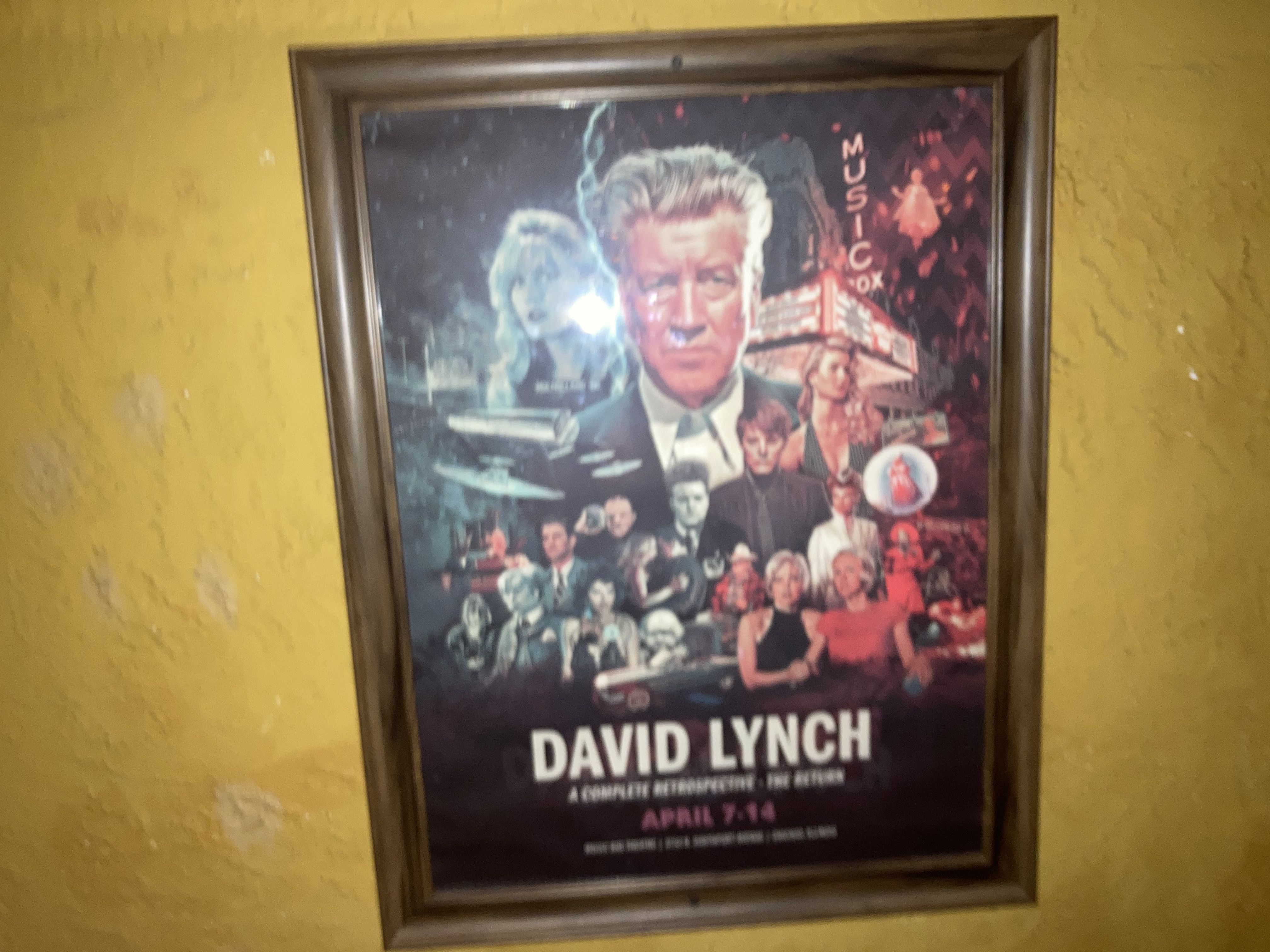
After watching my number one favorite film of all-time, I looked at all the awesome posters on the walls in the lobby and below is a picture of one of many favorites 🙂

This poster was for a David Lynch Retrospective that was held from April 7-14 back in 2022.

-Click here to watch an incredible trailer for it.

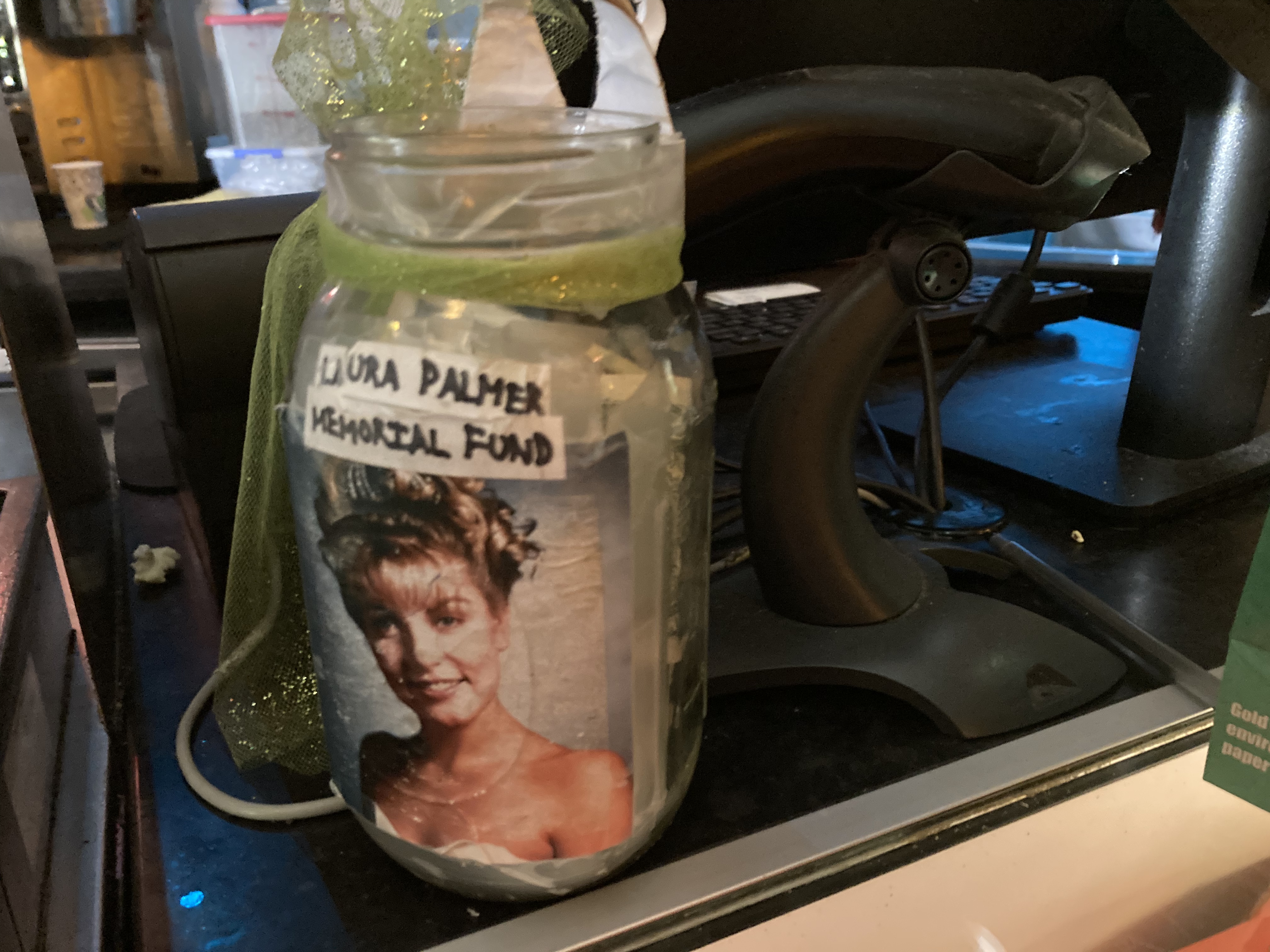
I actually think this is one of the most beautiful homages to a fictional film and television character, which in this case is actress Sheryl Lee’s Laura Palmer from Twin Peaks. As one can see from the picture, it is a dollar donation jar. As my dear readers might have guessed, I am a huge fan of the films of director David Lynch, everything Twin Peaks related and Sheryl Lee. This picture was taken on July 21 of this year when I saw director Akira Kurosawa’s Seven Samurai in a 4K Restoration on the big-screen.

I also wanted a picture of me holding the aforementioned donation jar and I got my chance. As one can notice, I am very happy in this photo. To this day, along with Nicolas Roeg’s Don’t Look Now, David Lynch’s Twin Peaks: Fire Walk with Me ranks for myself as one of the most emotionally powerful horror films ever made. As the beautiful and tragic Laura Palmer in the latter, Sheryl Lee gave a performance for the ages. Palmer’s descent into madness in that film always moves me to tears. As viewers, we want to reach into the screen to rescue Laura and then console her. Any director who can incite those feelings into us (in this case, Lynch) is doing something right.

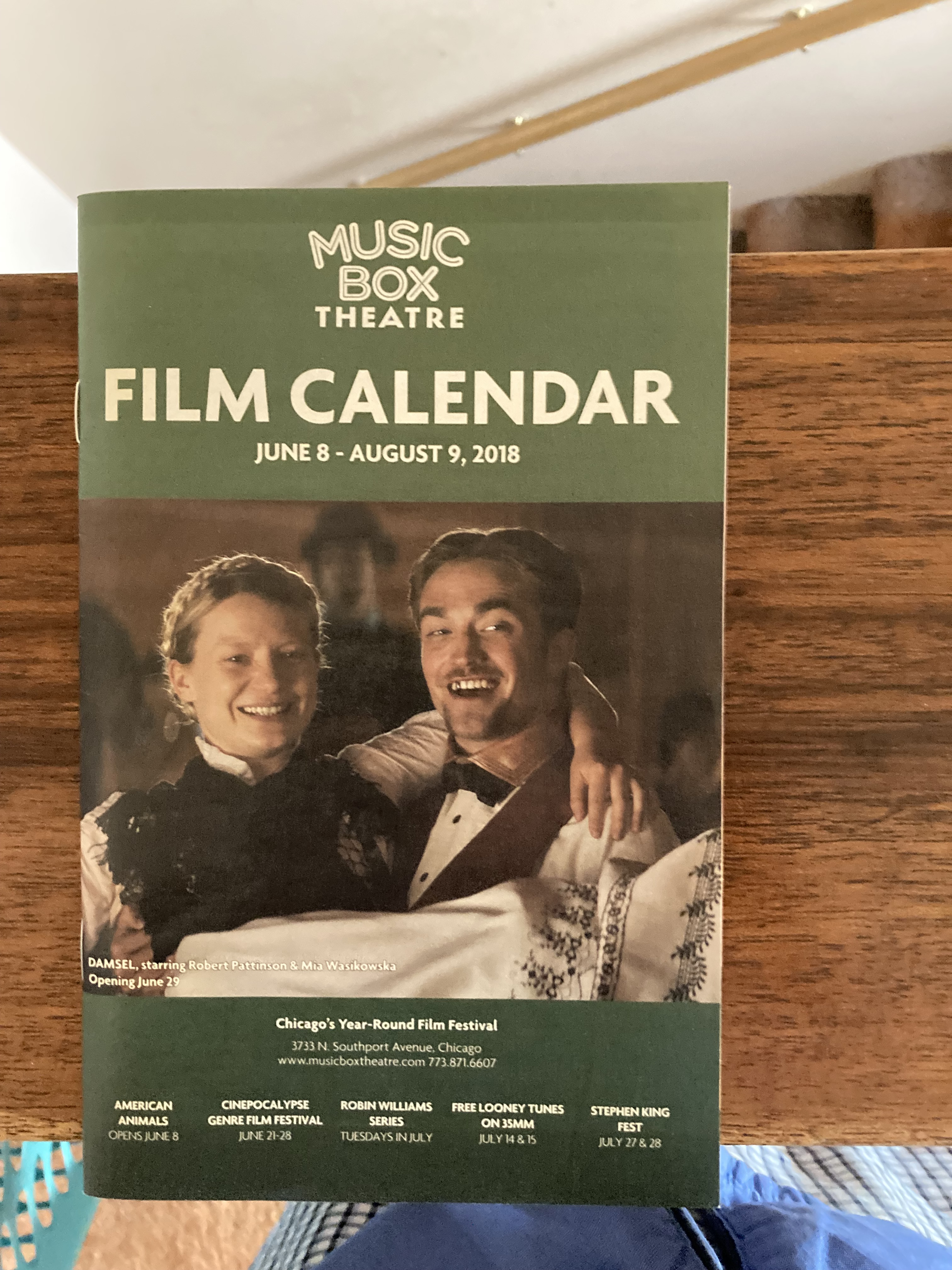
This photo was taken today, but this Film Calendar is from the Summer of 2018 as one can deduce from the picture. In October of that same year, I saw director John Carpenter’s 1982 masterpiece The Thing in 70 mm.

Once Again, this photo was today, but this CINEPOCALYPSE calendar was from the Summer of 2018. I saw director Stephen Hopkins tightly-paced Chicago set 1993 Neo-noir action thriller Judgment Night there. I took a picture with Hopkins that has unfortunately been lost to time due to the fact taken on my old IPhone 😦 I do not know If it is just me, but director Alex Cox’s 1984 Sci-fi/Neo-noir/comedy Repo Man would be perfect for that. I do not know If CINEPOCALYPSE is still annually there though.

Back in August of this year (in this case 2024), the Music Box Theatre got a spectacular renovation that included drink holders – I noticed this when I saw Vertigo in 70 mm two Sundays ago 🙂 Click here to read more about it.

-Click here to watch this clever trailer (or lack thereof) for it 🙂

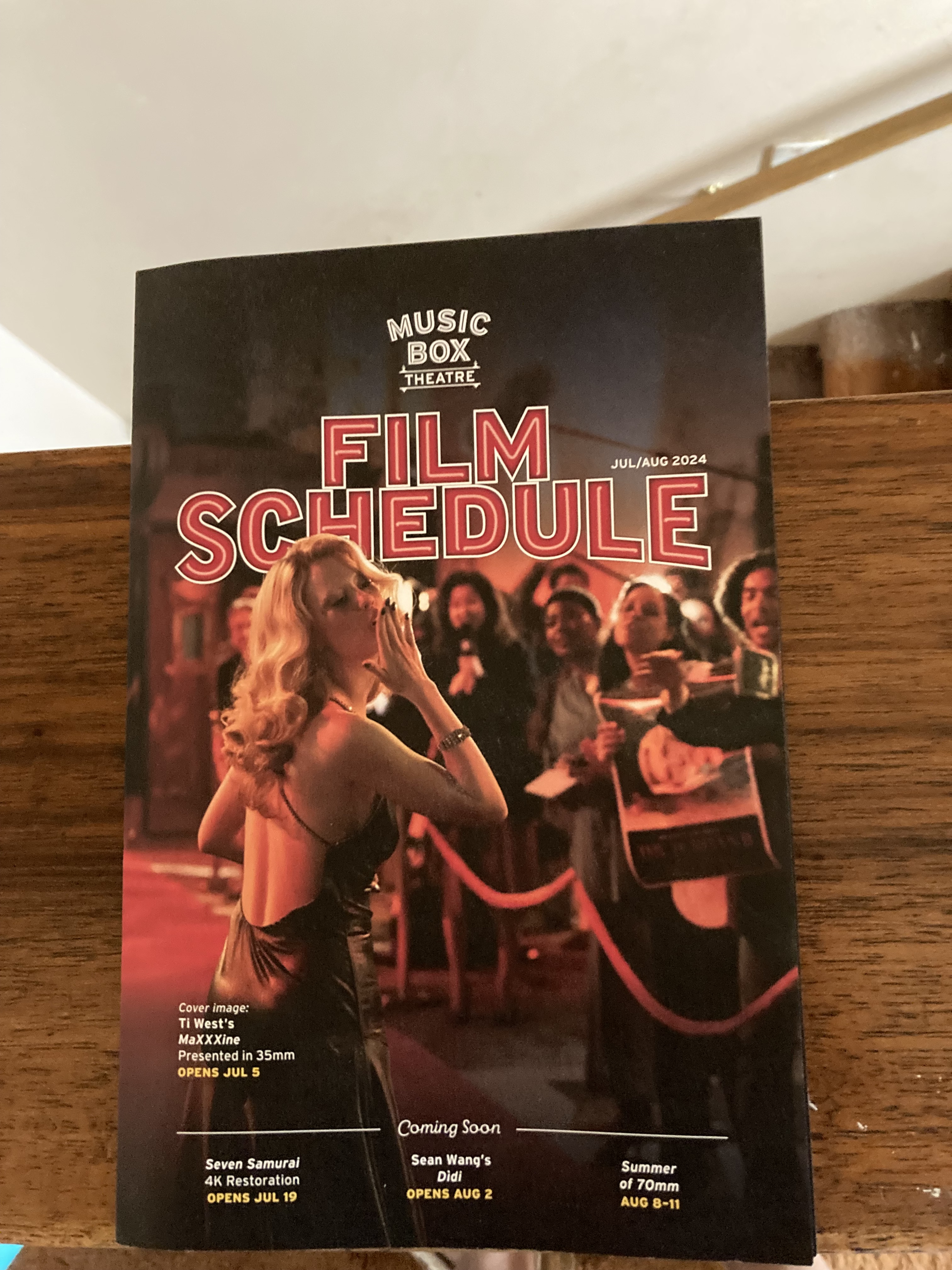
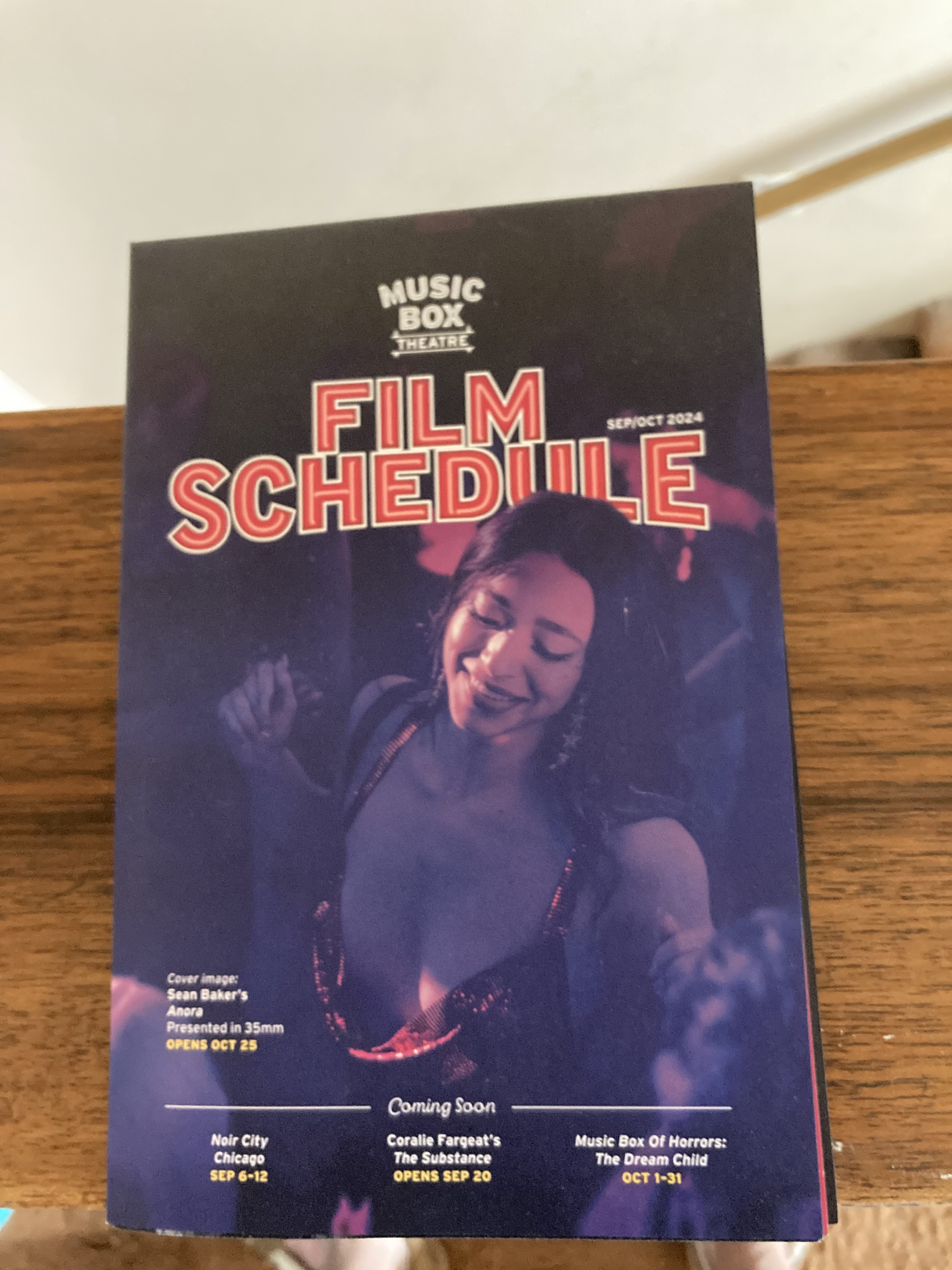
I picked up one of these Film Schedules back in July when I saw Seven Samurai there. I also saw the classic 1959 spy thriller North by Northwest (also directed by Hitchcock) in 70 mm back on August 11 of this year. That last title was part of their Summer of 70 mm series.

-Click here to watch the trailer for it.

I picked up one of these Film Schedules when I saw Vertigo in 70 mm two Sundays ago.

-In Closing-

All in all, I want to thank Chicago’s Music Box Theatre for the wonderful time I had watching my number one favorite film of all-time (in this case Vertigo) on a big-screen in 70 mm. All of you keep up the great work as always 🙂

-If any of my dear readers are interested in more info, click here to watch an 11-minute video celebrating the 90th anniversary of the Music Box Theatre from the Summer of 2019.

-Further Reading-

Click here to read my 2022 blog entry regarding My Top 10 Favorite Films of All-Time

Click here to read my 2023 blog entry regarding My Top 10 Favorite Horror Films of All-Time

Click here to read my 2023 blog entry regarding My 100 Favorite Films (1-100)

Click here to read my 2024 blog entry entitled Vertigo (1958) – A Ten-Part Personal Essay Written By Me

Click here to read my 2024 blog entry wishing actress Sheryl Lee a Happy 57th Birthday

-Questions for My Dear Readers-

1.) Name one of your favorite films that you have watched on a big theater screen? (70 mm or otherwise)

2.) Describe the excitement in your own words what it was like watching it on a big theater screen. What was it like?

3.) What theater/theatre did you see it at?

4.) As a follow-up to question #3, was there anything in the theater/theatre lobby that interested you (i.e. poster or otherwise)?

R.I.P. Alain Delon (1935-2024)

Along with Gena Rowlands, the cinephile community lost another giant this past month on August 18. In this case, it is Alain Delon – one of the most iconic French actors of all-time. He was 88 years-old and the cause of death was B-cell lymphoma. On the screen, Delon oozed coolness and sexiness in equal measures. Various actors, artists, directors and musicians among others have cited Delon as an influence on their work. As usual, I could go on, but I want to finish this blog entry by citing some of my favorite films with Delon (all * * * * out of * * * *).

  1. Purple Noon (1960) (Dir: Rene Clement) Click here and here to watch two various trailers
  2. Rocco and His Brothers (1960) (Dir: Luchino Visconti) Click here and here to watch two various trailers
  3. L’Eclisse (1962) (Dir: Michelangelo Antonioni) Click here to watch a various trailer for it
  4. The Leopard (1963) (Dir: Luchino Visconti) Click here and here to watch two trailers
  5. Any Number Can Win (1963) (Dir: Henri Verneuil) I could not find an English subtitled trailer for it
  6. Le Samourai (1967) (Dir: Jean-Pierre Melville) Click here to watch a 4K Restoration trailer for it
  7. La Piscine (1969) (Dir: Jacques Deray) Click here and here to view two different 4K Restoration trailers for it
  8. The Sicilian Clan (1969) (Dir: Henri Verneuil) Click here to watch a trailer for it
  9. Le Cercle Rouge (1970) (Dir: Jean-Pierre Melville) Click here to watch a 4K Restoration trailer for it
  10. Un flic (1972) (Dir: Jean-Pierre Melville) Click here to watch a trailer for it
  11. Tony Arzenta (1973) (Dir: Duccio Tessari) Click here to watch a trailer for it
  12. Mr. Klein (1976) (Dir: Joseph Losey) Click here to watch a 4K Restoration trailer for it
  13. Nouvelle Vague (1990) (Dir: Jean-Luc Godard) I could not find a trailer for that one

I would like to end this blog entry with a question for my dear readers below

What is your favorite Alain Delon film?

R.I.P. Gena Rowlands (1930-2024)

Last Wednesday, one of the most extraordinary actresses to have ever lived passed away at the age of 94. The actress was Gena Rowlands. The cause of death was complications of Alzheimer’s disease (read here and here). According to her son Nick Cassavetes (read here), Rowlands had been living with Alzheimer’s for the past five years. And yes, Nick is the son of the late great actor/director/writer John Cassavetes. Rowlands had been married to John from 1954 until his death in 1989. To commemorate her career, I will list my favorite films of hers where she serves as a standout below (all * * * * out of * * * *).

  1. Faces (1968) (Dir: John Cassavetes) Click here to view the film’s original theatrical trailer
  2. Minnie and Moskowitz (1971) (Dir: John Cassavetes) Click here to view the film’s original theatrical trailer
  3. A Woman Under the Influence (1974) (Dir: John Cassavetes) Click here to view the film’s original theatrical trailer
  4. Opening Night (1977) (Dir: John Cassavetes) Click here to view the film’s original theatrical trailer
  5. Gloria (1980) (Dir: John Cassavetes) Click here to view the film’s original theatrical trailer
  6. Love Streams (1984) (Dir: John Cassavetes) Click here to view the film’s original theatrical trailer
  7. The Notebook (2004) (Dir: Nick Cassavetes) Click here to view the film’s original theatrical trailer

I would like to end this blog entry with a question for my dear readers below

What is your favorite Gena Rowlands film?

Happy 98th Birthday Marilyn Monroe

This blog entry was originally posted last year on June 1, 2023 to celebrate Classical Hollywood era icon Marilyn Monroe’s then 97th birthday – or what would have been her then 97th birthday. Almost everything written here for her 98th birthday remains the same.

A polite reminder before reading this blog entry of mine 🙂 I will not tolerate any insults or negativity towards my subject of this post. This blog entry is strictly for dyed-in-the-wool Marilyn Monroe fans like myself or fans in general. So once again, please be kind 🙂

This Happy Birthday blog entry is dedicated to Classical Hollywood era icon Marilyn Monroe, who would have been 98 years-old today on June 1. In other words, I would like to wish a very Happy Birthday to Marilyn Monroe. Considering that her tragic life has been dwelled upon endlessly, misunderstood by men and women alike (well-intentioned or otherwise), not to mention exploited, I am dedicating this entry solely to Marilyn Monroe’s achievements onscreen. For myself, Marilyn Monroe is truly the embodiment of a goddess. In other words, Monroe is an iconic sex symbol, who succeeds brilliantly at both comedy and drama. When it came to the former, Marilyn Monroe took the stereotypical dumb blonde (a term I hate) persona of her characters and deconstructed it. For example, click here to see what I mean. To put it in other words, it is us viewers, who come off as the bumbling idiots for thinking that she was one 🙂 I could link to many others, but for me, no other comedy of Monroe’s demonstrates her deconstruction of the aforementioned trope given to her more perfectly than in Gentlemen Prefer Blondes. As for the latter, Monroe displayed her dramatic chops masterfully in quite a few films. Once again, I could ramble on and on, but If I had to single out my number one favorite in terms of drama, it would be her performance as Cherie in Bus Stop. Check out Monroe’s bus conversation scene by clicking here and her rendition of That Old Black Magic by clicking here. Speaking of which, my number one favorite Monroe rendition also happens to be her most iconic – Diamonds Are a Girl’s Best Friend. The number features Monroe wearing a shocking pink dress (designed by William Travilla) singing about her love of diamonds surrounded by adoring men dressed in suits and bow ties (and much more). Click here to watch the link – the number begins at the 0:50 mark. Cover versions post-1953 range from Lena Horne to Megan Thee Stallion (read here). In addition, entertainers ranging from singer Madonna to actress Margot Robbie (read here) have not only paid homage to Gentlemen Prefer Blondes aforementioned musical number, but also wore pink dresses similar to the one Monroe was dressed in while performing it.

Before I share with you dear readers all of my favorite Marilyn Monroe films, I would like to show you all some links below.

Here is a link to an appreciation of Gentlemen Prefer Blondes by one of my many favorite female writers, which in this case is the Chicago-based film aficionado Caroline Siede

Here is a youtube video link to another iconic number from the film entitled Two Little Girls from Little Rock

My UK readers may have seen the above musical number parodied by British comediennes Dawn French and Jennifer Saunders on the long running sketch comedy series French and Saunders – click here

Here is a youtube video link to legendary French actress Catherine Deneuve and her late older sister Francoise Dorleac performing the song Chanson d’un jour d’ete (Summer Day Song) in Jacques Demy’s 1967 musical masterpiece The Young Girls of Rochefort. In the film, the two actresses play twins. The musical number and the dresses worn by the two leading ladies are subtly similar (If not completely) to how Two Little Girls from Little Rock was performed. Click here to view the dubbed in English version.

Here is a youtube video link to musician Madonna’s 1985 Material Girl music video, which references the Diamonds Are a Girl’s Best Friend musical number

Here is a youtube video link to musician Kylie Minogue’s homage to the Diamonds Are a Girl’s Best Friend musical number from the 1999 Grand Opening of Fox Studios in Australia

Here is a youtube video link to actress Nicole Kidman’s version of Diamonds Are a Girl’s Best Friend in the 2001 musical romance Moulin Rouge

The 2010’s American television series Glee also paid homage to Diamonds Are a Girl’s Best Friend (and briefly Material Girl) in an episode. Click here to watch

American comedienne Rachel Bloom loosely parodied the visual style of Diamonds Are a Girl’s Best Friend (only replace anything colored red and pink with blue) in an episode of the satirical 2010’s CW television program Crazy Ex-Girlfriend – click here and here to see it

Here is a youtube video link to American broadcast journalist Edward R. Murrow’s 1955 Person to Person interview with Marilyn Monroe

Here is a youtube video link to American television personality Dave Garroway’s 1955 audio interview with Marilyn Monroe

Here is a youtube video link to a brief 1960 audio interview with Marilyn Monroe. I do not know who is conducting it though

Also, for more Marilyn Monroe fandom, click on these two youtube channel links here and here. The first channel is titled Marilyn Monroe Video Archives and the second is called The Marilyn Monroe Channel

One more thing, I do not know If any of my readers subscribe to the Criterion Channel streaming service, but If any of you do, last year in June of 2023, the streaming service featured most of Marilyn Monroe’s films – click here to view the trailer

Click here to view a youtube video link of actor Ryan Gosling singing the Oscar nominated song from 2023’s Barbie entitled I’m Just Ken from the Academy Awards back in March of 2024. The style of the performance is sort of similar to Marilyn Monroe’s Diamonds Are a Girl’s Best Friend number in Gentlemen Prefer Blondes

Now without further ado, below is a list of my favorite Marilyn Monroe films 🙂 All of them I gave * * * * (out of * * * *) stars to

  1. Ladies of the Chorus (1948) (Dir: Phil Karlson) There is no original theatrical trailer to the film, but one could watch the film on youtube
  2. The Asphalt Jungle (1950) (Dir: John Huston) Click here to view the film’s original theatrical trailer
  3. All About Eve (1950) (Dir: Joseph L. Mankiewicz) Click here to view the film’s original theatrical trailer
  4. Clash by Night (1952) (Dir: Fritz Lang) Click here to view the film’s original theatrical trailer
  5. Don’t Bother to Knock (1952) (Dir: Roy Ward Baker) Click here to view the film’s original theatrical trailer
  6. Monkey Business (1952) (Dir: Howard Hawks) Click here to view the film’s original theatrical trailer
  7. O. Henry’s Full House (1952) (Dir: Harry Koster)
    (Segment: The Cop and the Anthem) Click here to view the film’s original theatrical trailer
  8. Niagara (1953) (Dir: Henry Hathaway) Click here to view a colorized version of the film’s original theatrical trailer
  9. Gentlemen Prefer Blondes (1953) (Dir: Howard Hawks) Click here to view the film’s original theatrical trailer
  10. How to Marry a Millionaire (1953) (Dir: Jean Negulesco) Click here to view the film’s original theatrical trailer
  11. River of No Return (1954) (Dir: Otto Preminger) Click here to view the film’s original theatrical trailer
  12. There’s No Business Like Show Business (1954) (Dir: Walter Lang) Click here to view the film’s original theatrical trailer
  13. The Seven Year Itch (1955) (Dir: Billy Wilder) Click here to view the film’s original theatrical trailer
  14. Bus Stop (1956) (Dir: Joshua Logan) Click here to view the film’s original theatrical trailer
  15. The Prince and the Showgirl (1957) (Dir: Laurence Olivier) Click here to view the film’s original theatrical trailer
  16. Some Like It Hot (1959) (Dir: Billy Wilder) Click here to view the film’s original theatrical trailer
  17. Let’s Make Love (1960) (Dir: George Cukor) Click here to view the film’s original theatrical trailer
  18. The Misfits (1961) (Dir: John Huston) Click here to view the film’s original theatrical trailer

Let me conclude this blog entry with three questions below for all of my dear readers

What were your favorite article links in this blog entry?

What are your favorite video links in this blog entry? Which ones did you all find the most fascinating?

Besides Some Like It Hot, what are your other favorite Marilyn Monroe films?

My Favorite Bernardo Bertolucci Films (2024 Edition)

I have not seen 2012’s Me and You yet because it is not available on Blu-Ray/DVD here in the United States nor can I watch it online.

* * * * (Out of * * * *)

  1. The Conformist (1970)
  2. Besieged (1998)
  3. Tragedy of a Ridiculous Man (1981)
  4. The Dreamers (2003)
  5. The Spider’s Stratagem (1970)
    (Italian Television)
  6. Before the Revolution (1964)
  7. Last Tango in Paris (1972)
  8. La Luna (1979)
  9. 1900 (1976)
  10. Stealing Beauty (1996)
  11. The Last Emperor (1987)
  12. The Sheltering Sky (1990)
  13. Partner (1968)
  14. Little Buddha (1993)
  15. The Grim Reaper (1962)
  16. Ten Minutes Older: The Cello (2002)
    Segment: Histoire d’eaux
  17. Il canale (1966)
    (Documentary)
    (Short)
  18. Love and Anger (1969)
    Segment: Agonia

My Favorite Busby Berkeley Films (2024 Edition)

* * * * (Out of * * * *)

  1. Gold Diggers of 1933 (1933)
    (co-directed with Mervyn LeRoy)
    (Musical numbers only)
  2. The Gang’s All Here (1943)
  3. Footlight Parade (1933)
    (co-directed with Lloyd Bacon)
    (Musical numbers only)
  4. 42nd Street (1933)
    (co-directed with Lloyd Bacon)
    (Musical numbers only)
  5. For Me and My Gal (1942)
  6. Hollywood Hotel (1937)
  7. Dames (1934)
    (co-directed with Ray Enright)
    (Musical numbers only)
  8. Gold Diggers of 1935 (1935)
  9. Romance on the High Seas (1948)
    (co-directed with Michael Curtiz)
    (Choreographer only)
  10. Gold Diggers of 1937 (1937)
    (co-directed with Lloyd Bacon)
    (Musical numbers only)
  11. She Had to Say Yes (1933)
    (co-directed with George Amy)
  12. Ziegfeld Girl (1941)
    (co-directed with Robert Z. Leonard)
    (Musical numbers only)
  13. They Made Me a Criminal (1939)
  14. Lady Be Good (1941)
    (co-directed with Norman Z. McLeod)
    (Musical numbers only)
  15. Bright Lights (1935)

* * * 1/2 (Out of * * * *)

  1. Strike Up The Band (1940)
  2. Babes in Arms (1939)
  3. Babes on Broadway (1941)

Happy 57th Birthday Sheryl Lee

A polite reminder before reading this blog entry of mine ðŸ™‚ I will not tolerate any insults or negativity towards my subject of this post. This blog entry is strictly for dyed-in-the-wool Sheryl Lee fans like myself or fans in general. So once again, please be kind ðŸ™‚

One more thing: I will not tolerate any negativity towards Twin Peaks: Fire Walk with Me or Twin Peaks in general. Any negative comments will be deleted, so I am politely asking you all to be kind to the subject of my post 🙂

Most of my dear readers are probably aware of this by now, but I am a massive fan of not only legendary director David Lynch and Twin Peaks (read here, here and here), but also of the immensely beautiful and talented actress Sheryl Lee, who portrayed the doomed Laura Palmer on the aforementioned series. So what better way to honor than to wish Sheryl Lee a very happy 57th birthday. If Twin Peaks: Fire Walk with Me had been widely acclaimed during it’s initial 1992 theatrical release, it is undeniable that she would have gone on to have a prestigious career. Thankfully, Twin Peaks: Fire Walk with Me has since been re-assessed as one of director Lynch’s greatest films. Lee deserved so much more after that, but then again, she was probably just too good for the mainstream. Even in brief appearances, Lee stands out. Based on all of the video links I am about to give, the words gorgeous, intelligent, kind-hearted, nice (and once again) talented are the ones that best describe Lee on a whole.

Since I would have to dedicate an entire different blog entry regarding every other four-star film she was in, I have decided to focus solely on her work in Twin Peaks. The one thing I can guarantee my dear readers here is that I gave everything Twin Peaks related * * * * (out of * * * *) stars. I would love to take this time to direct my dear readers to a bunch of links below regarding Lee and Twin Peaks: Fire Walk with Me:

Here is a youtube video link to a 2021 Q&A with actors Sheryl Lee and Dana Ashbrook at Chicago’s Music Box Theatre: during a special screening of Twin Peaks: Fire Walk with Me

Click here to view Part 1

Click here to view Part 2

Click here to view Part 3

Click here to view Part 4

Click here to view Part 5

Click here to view a 2013 HollywoodChicago.com interview with actresses Sheryl Lee and Sherilyn Fenn

Click here to view some past coverage of the Wizard World Chicago 2012 (now called Fan Expo Chicago) convention that featured actresses Sheryl Lee and Sherilyn Fenn as two of the guests.

Click here to view a preview of this 2019 Milwaukee Film Festival Q&A with actors Sheryl Lee and Ray Wise during a special screening of Twin Peaks: Fire Walk with Me. Also, click the two links below for the expanded Q&A between Lee and Wise:

Click here to view Part 1

Click here to view Part 2

Click here is a youtube video link to an interview recorded in 2019 with actress Sheryl Lee by the Indiana-based Twin Peaks youtube channel Take the Ring

Last, but not least, click here to view actress Sheryl Lee’s Facebook page

Click here to watch author Scott Ryan’s introduction to Twin Peaks: Fire Walk with Me during a 2021 showing at Chicago’s Music Box Theatre

Also, click here to view this adorable photo of actress Sheryl Lee and her son Elijah at a Los Angeles 2017 premiere of Twin Peaks: The Return

Click here to listen to the Twin Peaks: Fire Walk with Me soundtrack composed by the late great Angelo Badalamenti

Click here to listen to the Twin Peaks Theme and here for Laura Palmer’s Theme – also composed by Badalamenti

Click here to view the original theatrical trailer to Twin Peaks: Fire Walk with Me

Now I have a question for all of my dear readers below:

What video link is your favorite or which one, fascinated you the most?