A polite reminder before reading this blog entry of mine 🙂 I will not tolerate any insults or negativity towards any of the films or people I mention in this post. Any negative comments will be deleted, so I am politely asking you all to please be kind 🙂
-Sunday, September 15, 2024 – 2 pm-
On an absolutely gorgeous sunny afternoon on that aforementioned day and time above, I was absolutely filled with joy as I got to watch my number one favorite film of all-time on a big-screen in 70 mm. The film in question was director Alfred Hitchcock’s 1958 American classic Vertigo. I saw a 2:30 pm showing at the historic Music Box Theatre in Chicago, Illinois. Before I get started with my thoughts, I would love to share a few awesome pictures that I posted below 🙂
This is my ticket for the 09/15/2024 2:30 pm showing for Vertigo in 70 mm 🙂
This is a picture of the original poster for Vertigo designed by the iconic Saul Bass 🙂Of course it did not include that smudge on the left side 🙂
Behold – The Music Box Theatre in all of it’s glory 🙂
Below are two pictures of me standing in front of the Music Box Theatre – which picture do you all prefer? 🙂
I am full of happiness at getting to see Vertigo on a big-screen in 70 mm 🙂
Still full of happiness 🙂
Now this poster for Vertigo was from a February 15-28th 2013 showing on a big-screen in 70 mm, but I had to take a picture of it nonetheless 🙂
-My Experience Watching Vertigo (1958) on a Big-Screen in 70 mm-
First things first, Vertigo (or at least in my view) looks amazing on either a television (for me, an HDTV) or a big theater screen. Here, I will talk about my experience watching Robert A. Harris and James C. Katz’s1996 restoration of the film that resulted in the 70 mm print that we have all watched ever since.
From iconic designer Saul Bass’s characteristically expressive title sequence to the denouement, Vertigo proved to be every bit as spectacular on a big theater screen in 70 mm as it has on my HDTV at home. Imagine the size of how the film is presented on a latter and then times it’s height and width by 10, 15, 20 or beyond and you get an experience resembling a pure spectacle (i.e. Lawrence of Arabia).
As just one of many people watching Vertigo that day in a huge theater room on a big-screen (If this was not a sold out showing, it certainly came very close), my viewing experience was not only every bit as involving there as it was at home, but in some ways, five times more so.
Each viewing of Vertigo involves me on not only an intellectual level, but a visual one as well. No surprise given that the 1996 restoration resulted in a 70 mm print of the film. When viewed on a big theater screen, the visual experience becomes even more exhilarating. Every exterior and interior makes one feel like a tourist visiting a landmark. While the same vibe can be felt when viewed at home, on a big theater screen, it comes off as more explicit. Same sentiments apply to the dolly zoom shots and the famed dream sequence.
Final word of note on this subject, like all truly great films, Vertigo offers something I did not notice on the previous viewing. In this case, it comes from the film’s use of lighting. The scene in question takes place in Big Basin Redwoods State Park. As John “Scottie” Ferguson (James Stewart) and Madeline Elster (Kim Novak) are walking, the lighting on Madeline’s white coat makes her look like a ghostly figure, which is fitting considering that her character thinks that she is possessed by a dead woman.
-On the Side-
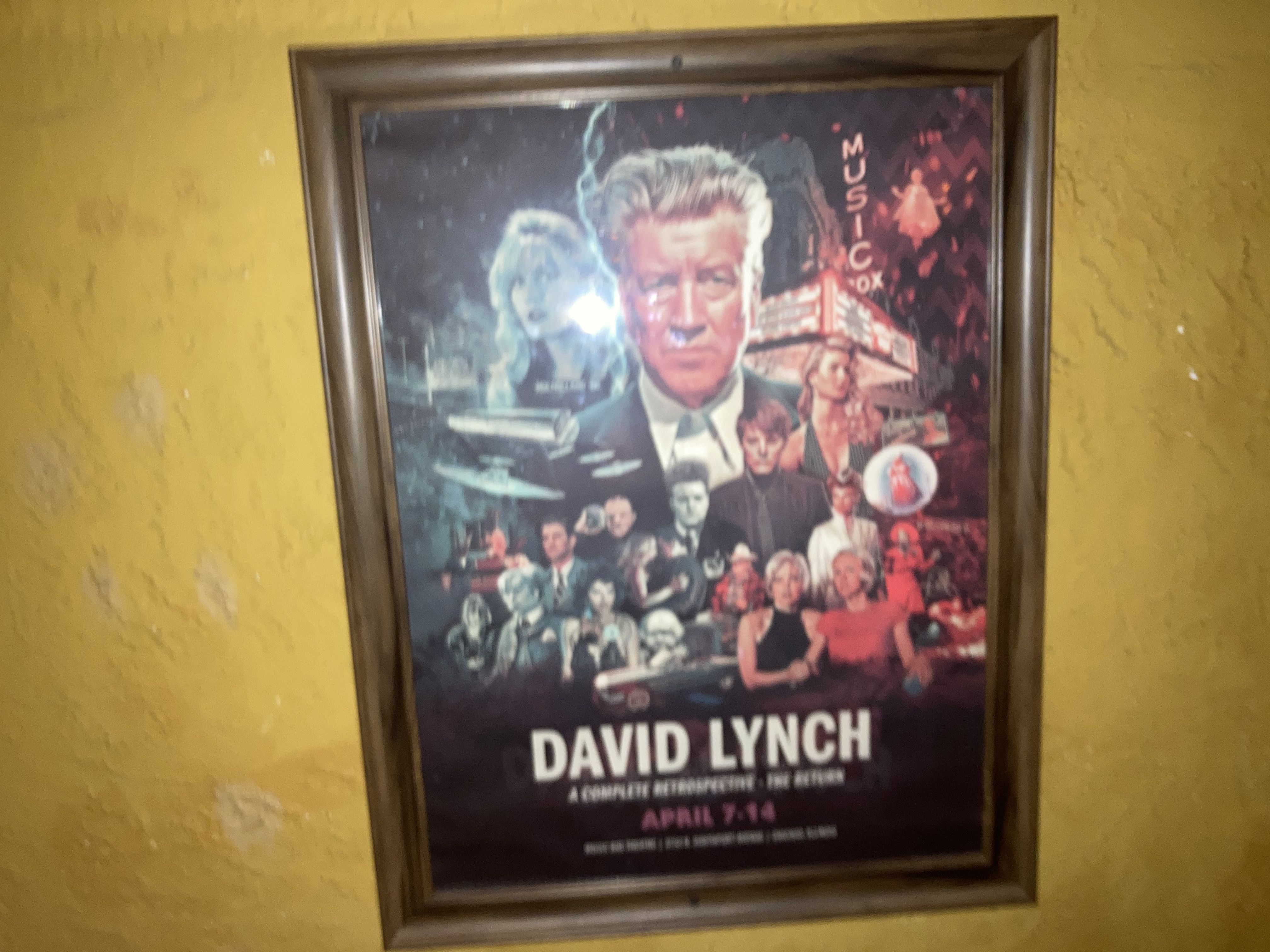
After watching my number one favorite film of all-time, I looked at all the awesome posters on the walls in the lobby and below is a picture of one of many favorites 🙂
This poster was for a David Lynch Retrospective that was held from April 7-14 back in 2022.
-Click here to watch an incredible trailer for it.
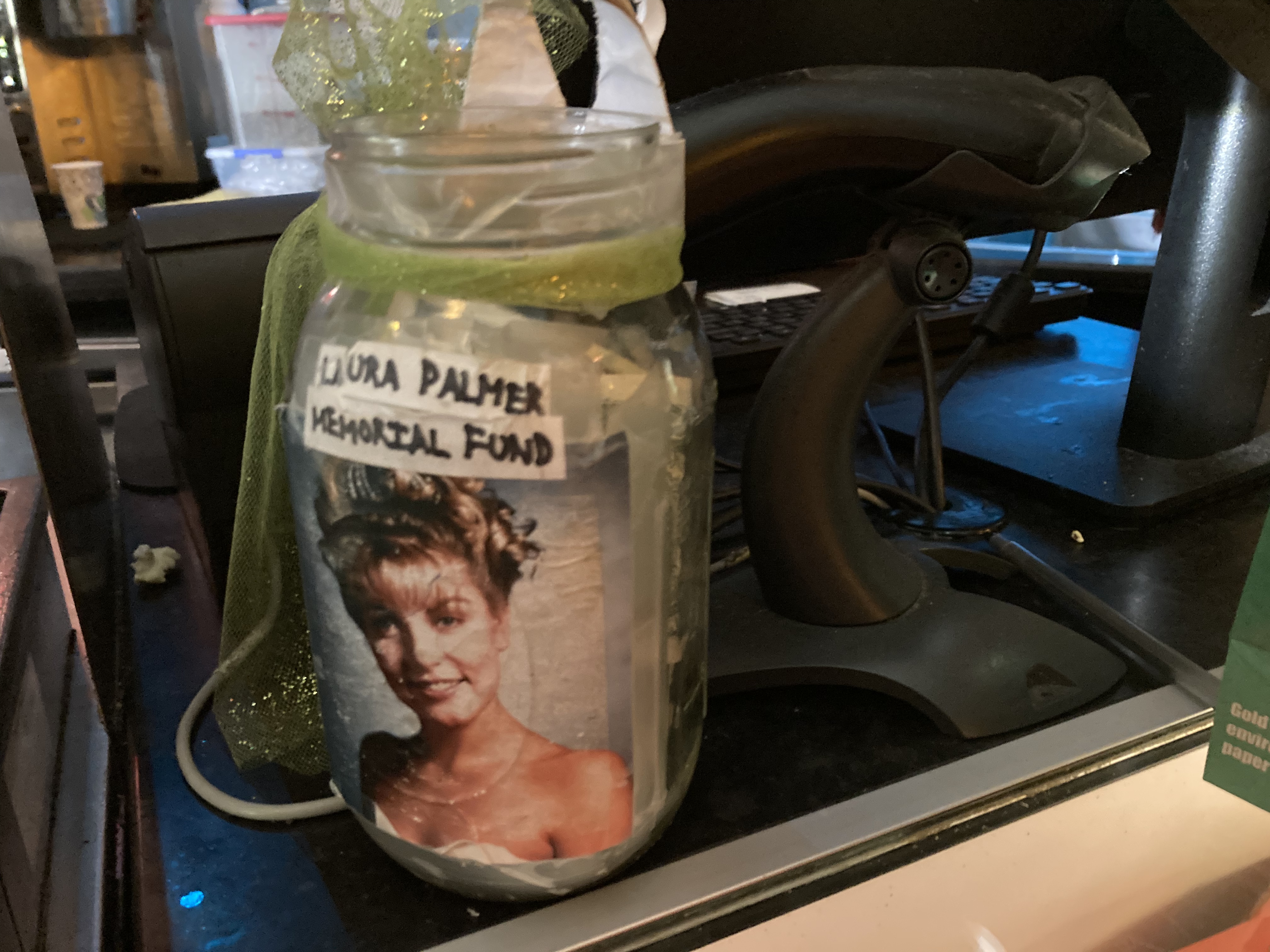
I actually think this is one of the most beautiful homages to a fictional film and television character, which in this case is actress Sheryl Lee’s Laura Palmer from Twin Peaks.As one can see from the picture, it is a dollar donation jar.As my dear readers might have guessed, I am a huge fan of the films of director David Lynch, everything Twin Peaks related and Sheryl Lee.This picture was taken on July 21 of this year when I saw director Akira Kurosawa’sSeven Samurai in a 4K Restoration on the big-screen.
I also wanted a picture of me holding the aforementioned donation jar and I got my chance. As one can notice, I am very happy in this photo. To this day, along with Nicolas Roeg’sDon’t Look Now, David Lynch’sTwin Peaks: Fire Walk with Me ranks for myself as one of the most emotionally powerful horror films ever made. As the beautiful and tragic Laura Palmer in the latter, Sheryl Lee gave a performance for the ages. Palmer’s descent into madness in that film always moves me to tears. As viewers, we want to reach into the screen to rescue Laura and then console her. Any director who can incite those feelings into us (in this case, Lynch) is doing something right.
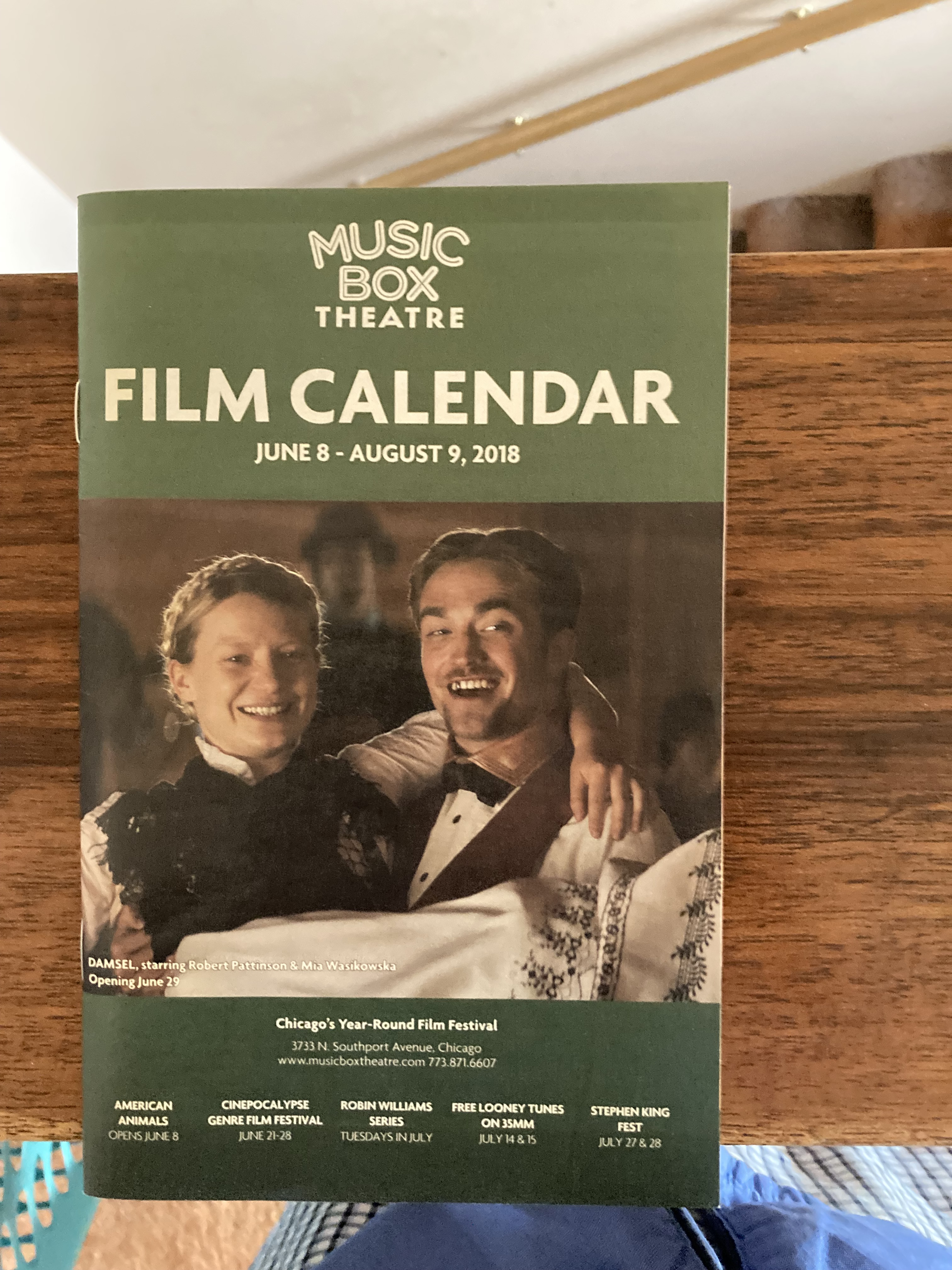
This photo was taken today, but this Film Calendar is from the Summer of 2018 as one can deduce from the picture. In October of that same year, I saw director John Carpenter’s 1982 masterpiece The Thing in 70 mm.
Once Again, this photo was today, but this CINEPOCALYPSE calendar was from the Summer of 2018. I saw director Stephen Hopkins tightly-paced Chicago set 1993 Neo-noir action thriller Judgment Night there. I took a picture with Hopkins that has unfortunately been lost to time due to the fact taken on my old IPhone 😦I do not know If it is just me, but director Alex Cox’s 1984 Sci-fi/Neo-noir/comedy Repo Man would be perfect for that. I do not know If CINEPOCALYPSE is still annually there though.
Back in August of this year (in this case 2024), the Music Box Theatre got a spectacular renovation that included drink holders – I noticed this when I saw Vertigo in 70 mm two Sundays ago 🙂Click here to read more about it.
-Click here to watch this clever trailer (or lack thereof) for it 🙂
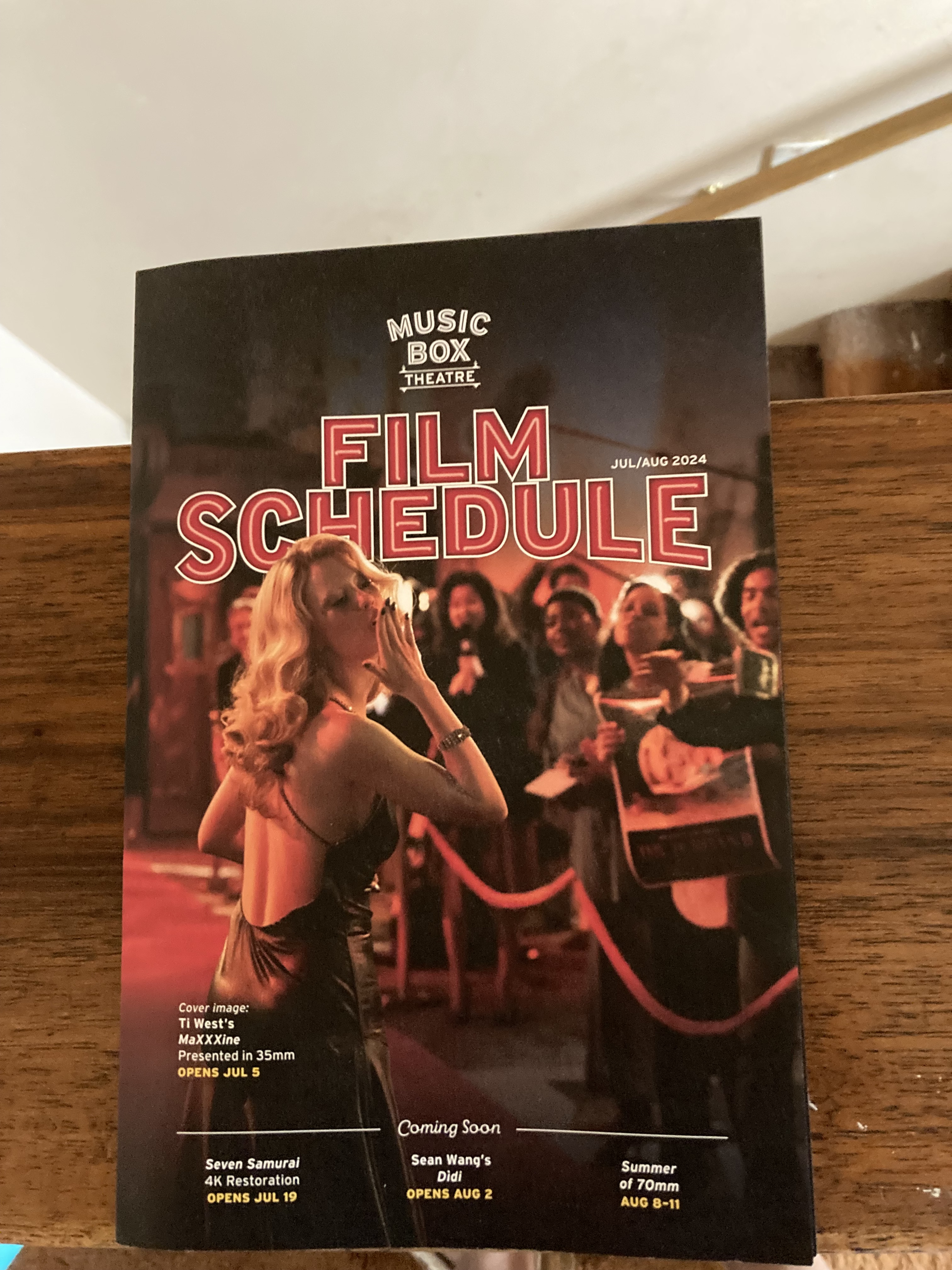
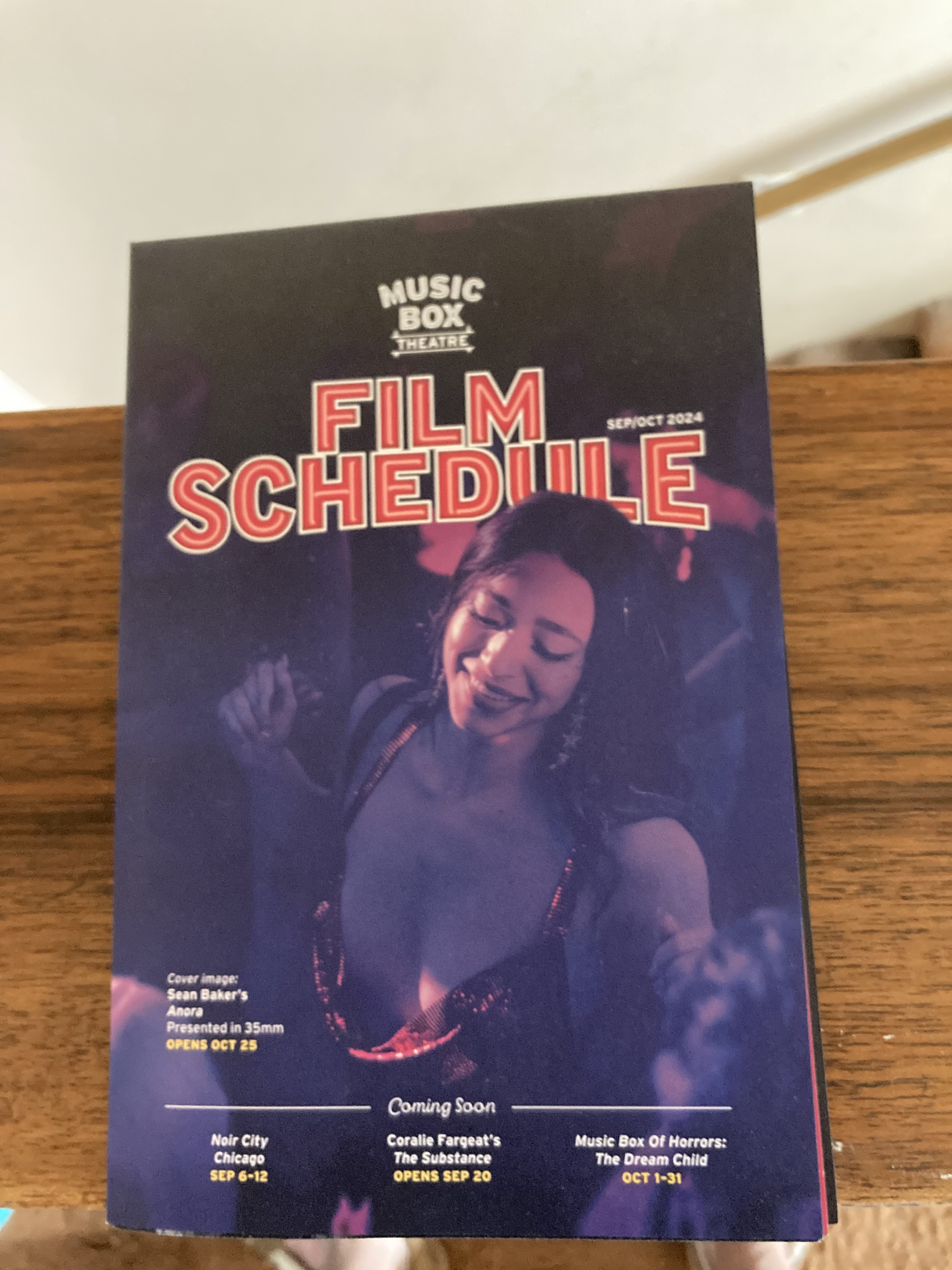
I picked up one of these Film Schedules back in July when I saw Seven Samurai there. I also saw the classic 1959 spy thriller North by Northwest (also directed by Hitchcock) in 70 mm back on August 11 of this year.That last title was part of their Summer of 70 mm series.
I picked up one of these Film Schedules when I saw Vertigo in 70 mm two Sundays ago.
-In Closing-
All in all, I want to thank Chicago’s Music Box Theatre for the wonderful time I had watching my number one favorite film of all-time (in this case Vertigo) on a big-screen in 70 mm. All of you keep up the great work as always 🙂
-If any of my dear readers are interested in more info, click here to watch an 11-minute video celebrating the 90th anniversary of the Music Box Theatre from the Summer of 2019.
-Further Reading-
Click here to read my 2022 blog entry regarding MyTop 10 Favorite Films of All-Time
Click here to read my 2023 blog entry regarding My Top 10 Favorite Horror Films of All-Time
Click here to read my 2023 blog entry regarding My 100 Favorite Films (1-100)
Click here to read my 2024 blog entry entitled Vertigo (1958) – A Ten-Part Personal Essay Written By Me
Click here to read my 2024 blog entry wishing actress Sheryl Lee a Happy 57th Birthday
-Questions for My Dear Readers-
1.)Name one of your favorite films that you have watched on a big theater screen? (70 mm or otherwise)
2.)Describe the excitement in your own words what it was like watching it on a big theater screen. What was it like?
3.) What theater/theatre did you see it at?
4.) As a follow-up to question #3, was there anything in the theater/theatre lobby that interested you (i.e. poster or otherwise)?
Warning: The review contains potential plot spoilers. If you have not seen this film than I advise you to not read any further.
Three years after he reinvented cinematic horror with Psycho in 1960, director Alfred Hitchcock (a.k.a. The Master of Suspense) would return to that genre in 1963 to do it again; this time with something more ambitious and on a much larger scale as well. The finished result was The Birds and with it, Hitchcock succeeded in not only equaling and surpassing his aforementioned previous effort, but at the same time, everything he did before and after this. If I were to compose two lists of my top 100 or more favorite films of all-time; with one dedicated to the horror genre and the other towards cinema as a whole, I would place The Birds at the number 1 spot on the former and somewhere in between numbers 1 and 10 on the latter.
While visiting an urban pet store one day to pick up a mynah bird for a relative, San Francisco socialite Melanie Daniels (Tippi Hedren) gets mistaken by a customer (Rod Taylor) for a saleswoman and requests a pair of lovebirds for his little sister’s 11th birthday party. As with the mynah bird, it turns out that the shop is out of lovebirds, so Melanie suggests a canary, which flies out of her hand after taking it out of it’s cage. After catching the canary with his hat, the still unnamed customer places the bird back in it’s cage and says: “back in your gilded cage Melanie Daniels.” A stunned Daniels asks him how he knew her name and it is revealed that he saw her in court. According to him, she was responsible for a practical joke that resulted in a broken glass window and personally feels that she should have been sent to jail for it. He purposely knew from the very beginning that Daniels was no saleswoman and reveals that it was his way of reminding her of “what it’s like to be on the other end of a gag” as he puts it. Undetered by not getting his lovebirds, he leaves with two closing remarks to Daniels: “I’ll find something else” and “see ya in court.” An annoyed Daniels decides to write down the number of the license plate on that customer’s car and calls the Department of Motor Vehicles to find out the name of the individual who owns it. In an attempt to get even with him, Daniels asks the pet shop owner to order a pair of lovebirds for her and have them delivered as soon as possible, which in this case would be the next morning.
The next day, Melanie Daniels arrives at the apartment building to place a birdcage (with the two lovebirds inside) on a doorstep with a note addressing that customer’s real name as “Mr. Mitchell Brenner.” Before leaving, a neighbor of his reminds her that he is visiting Bodega Bay, which is up the coast from San Francisco. Eager to get even with Mitch, Melanie drives up there and visits a local store to see If it’s owner knows where Mitch is residing for the weekend. Coincidentally, he knows the location of the place, which is across the dock seen close by. He knows that it belongs to his mother, but when asked about Mitch’s younger sister, he cannot seem to remember her first name. Nevertheless, he is able to direct her to a local schoolteacher by the name of Annie Hayworth (Suzanne Pleshette), who not only teaches Mitch’s younger sister, but also reveals herself to be Mitch’s ex-lover much later on. Upon learning that Cathy is the name of Mitch’s younger sibling, Melanie rents a motorboat to get to Mitch’s house to deliver her surprise. After placing the caged lovebirds on a comfy chair, Melanie tears up her original note for Mitch and replaces it with one carrying the words “To: Cathy” on it. Unofficially, Melanie hopes to shock Mitch with her knowledge of a family member’s identity much in the same way he did with hers the day before. Melanie rushes out of the house and back to her motorboat to see how Mitch will react when he inevitably goes back inside. Seemingly amused and curious, Mitch drives to the other side of the dock and gets out of his car to see what she will either say to him or do next. Suddenly, a seagull flies down and quickly attacks Melanie on the forehead prompting Mitch to help her out of the boat and treat her wound.
At the local diner, while treating her injury, Mitch Brenner reveals to Melanie Daniels that he is a criminal defense attorney, who practices law in San Francisco, but comes to Bodega Bay on the weekends to relax. After asking her why she is in the area, Melanie tells a lie and a half. Considering that Mitch is unaware of it being a prank yet humored and touched by the deed at the same time, Melanie tells him that she wanted to deliver the lovebirds for his little sister’s birthday. Deep down though, Melanie saw Mitch as a potential boyfriend ever since that first coincidental meeting at the pet store the day before. Even though Melanie denies it publicly, Mitch personally feels that she is in Bodega Bay to see him. Is it possible that Mitch could care less about her earlier prank and only got even with her that previous day so she could come to Bodega Bay to see him? The other lie Melanie tells Mitch is that she is visiting to see local schoolteacher Annie Hayworth (a.k.a. his ex-lover) by claiming that she and her were friends during their college years. Later that night, Melanie reluctantly accepts Mitch’s invitation to dinner to meet his younger sister Cathy (Veronica Cartwright), who adores both Melanie and the lovebirds she bought her and his widowed mother Lydia (Jessica Tandy), who initially fears her presence. As Ms. Daniels is about to leave to spend the night with Annie, a curious Mitch asks her to talk a bit more about herself in regards to a story brought up by Lydia earlier regarding Melanie frolicking naked in a waterfall while vacationing in Rome, Italy. Melanie claims that she was dumped in there with her clothes on and that the article his mother was referring to was written by a columnist hired by a rival of her father’s newspaper company to slander her family. Still unsatisfied, Mitch wants to know why she lied to him about knowing Annie resulting in an already annoyed Melanie to quickly drive away from him for a short period of time.
Later on at Annie Hayworth’s house, a curious Melanie Daniels asks Annie about her past relationship with Mitch Brenner, whom she was madly in love with at one time. According to Annie, she still desires a romantic relationship with him, but his overprotective mother Lydia just kept getting in the way and it eventually proved to be too much for her to take. Suddenly, Mitch phone calls Melanie to sincerely apologize for his earlier behavior and to make it up to her, he decides to officially invite her to celebrate his little sister Cathy’s 11th birthday party for the following day. Thinking back and forth for a while, Melanie decides to go. Shortly before both of them go to bed, a loud noise is heard from the outside. After opening the door to see what it is, Annie and Melanie discover a dead seagull on the front step. This is just the third strange occurrence that has plagued Bodega Bay since Melanie arrived. The first incident came earlier in the form of a seagull briefly attacking Melanie on the forehead and the second one involved the town’s chicken feed and why the chickens were not eating it. The next day at Cathy’s birthday party, numerous birds begin to violently attack the party guests and shortly after that, Mitch fends off a bird attack within his own home. From here on out, these incidents prove to be just two of the numerous attacks the birds will launch on the town and it’s inhabitants.
On the surface, The Birds plays out as a standard horror film about humans being attacked by the title villains. Nevertheless, in the hands of it’s iconic director and producer Alfred Hitchcock, it inevitably goes much deeper than that. Along with Vertigo and Psycho, this one requires viewers to pay close attention to every single detail that unfolds on screen from beginning to end. Not unlike what he had achieved with those two classics, Hitchcock proves once again here that the power of cinematic storytelling lies not so much in the payoff as it does in the buildup. While this can easily be said about any of the master filmmaker’s best work, it is in The Birds where Hitchcock finds himself reaching his fullest expression of that particular trait.
As much as I adore Jamaica Inn and Rebecca, The Birds still ranks for me as my favorite of director Alfred Hitchcock’s three film adaptations of a Daphne du Maurier property. Instead of merely adapting du Maurier’s 1952 novelette of the same name, Hitchcock simply reimagines it by using a 1961 Santa Cruz Sentinel article as “research material for his latest thriller”. – (read here). The piece itself was about a large number of seabirds unexplainably attacking the city of Capitola, California on August 18th of that year. Eventually, it turned out that the birds may have been “under the influence of domoic acid” (read here) at the time of the attacks. To further expand upon this idea, Hitchcock hired famed crime/mystery fiction writer Evan Hunter (a.k.a. Ed McBain) to write a screenplay that would effortlessly move from one tone into another. All through the first half-hour, viewers are intentionally tricked into thinking that the mood is going to play out like a sophisticated romantic comedy based on the playful banter between Melanie Daniels and Mitch Brenner. Thirty minutes into the film, that feeling more or less dissipates as it turns into something resembling a psychological drama that expands upon and rivals Psycho in it’s depiction of the darker side of a mother and son relationship. Finally, seven minutes before the second hour, it ultimately becomes an apocalyptic horror movie and a truly terrifying one at that. Hitchcock seemed to believe so himself based on the film’s legendary trailer (see below), which among other things, visually illustrates the question of “WHAT IS THE SHOCKING MYSTERY OF THE BIRDS?” across the screen. Unlike Hitchcock’s other films though, the mystery of The Birds remains unsolved and in a stroke of genius, Hitchcock and Hunter leave it up to viewers to answer the question for themselves.
Symbolically and thematically, The Birds is mainly a film about complacency as seen from director Alfred Hitchcock’s point-of-view (read here). I agree, but I am going to go one step beyond with not one, but two debatably complex interpretations. Prior to 1970, or maybe even five years earlier, one’s own praise of The Birds as Hitchcock’s most elaborate prank to date would be doing it complete justice. On the one hand, he is subtly thumbing his nose at upper class society by using the Melanie Daniels character as his target. True, Melanie may not have literally delivered the resulting chaos, but she might have done so figuratively in the form of her harmless prank involving the delivery of two lovebirds. The hysterical mother in the diner summed it up best when she said “I think you’re the cause of all of this. I think you’re evil. EVIL!” Later on and in a strange twist of irony, the birds viciously attack Melanie and this possibly gives off the vibe that her prank has backfired. On the other hand, Hitchcock does not seem too fond of small town sanctimony either. Since the plot already deals with birds violently attacking residents of a tiny village, Hitchcock is now officially left with doing nothing else but sitting back and enjoying the show like the rest of us.
Taking into consideration all of the radical changes that shaped the decade as it continued and ended, The Birds also comes off as a film that eerily foreshadowed the death of early 1960’s optimism and the slow, but steady decline of the nuclear family in a rather symbolic way. The lighthearted elements that defined the first half hour quite possibly resembles the stereotypical cheery mood that preceding American President Dwight D. Eisenhower (1953-1961) passed on to his successor John F. Kennedy (1961-1963), who briefly upheld this notion in the earlier days of his presidency. Contrary to the first 30 minutes, the second half hour carries a cautiously optimistic tone as we learn more about the characters. This unexpected feeling of cynicism coincides perfectly with the notable disappointments of the Kennedy era that include the failed 1961 Bay of Pigs Invasion (read here), his escalation of the Vietnam War beginning that same year (read here) and to some extent, the 1962 Cuban Missile Crisis (read here). Shortly after turning into a horror movie near the end of the first hour, viewers get a fairly graphic glimpse of the birds first casualty by way of a neighboring farmer. Psychologically, our terrified reactions at this sight mirrors that of the American public’s when Kennedy was assassinated in Dallas, Texas on November 22nd, 1963 (read here). Amid all of these previous events, the status of the nuclear family suddenly began to deteriorate. Two characters in The Birds demonstrate this aspect quite powerfully. In the case of Melanie Daniels, we get a wealthy woman, who admits to Mitch Brenner that her mother ditched her and her father when she was 11 years-old for “some hotel man in the East” before getting briefly emotional about her revelation. The other one comes in the form of Mitch’s widowed mother Lydia, who wishes that she “was a stronger person.” While sipping on a cup of tea, she laments to Melanie about how much she misses her husband (whom she reveals as Frank), who was not only able to connect with Mitch and Cathy on so many levels, but whose presence always gave her a sense of security deep down. Ever since his death from four years back, Lydia has felt insecure and she painfully admits to Melanie that “it’s terrible how you, you depend on someone else for strength and then suddenly all the strength is gone and you’re alone.” In many ways, Lydia can’t help but remain dependent on Mitch because she does not want him to abandon her given how she implicitly looks upon her recent self as that of a failure. When Lydia becomes anxious on the status of the bird attacks, Mitch comes to feel like one himself when she expresses all of her worries and all he can say is “I don’t know.” A hysterical Lydia than screams something along the lines of “If only your father were here” before sincerely apologizing to him a few seconds later. One scene visually expresses this by having Mitch sitting down in front of a portrait that may be his late father. While Melanie, Lydia and Cathy are sitting down waiting for the radio news report, he sits there looking like he is struggling to be as larger than life as his father apparently was. Unlike Norman Bates in Psycho, Mitch does not really see himself as a mama’s boy. While he does love Lydia (his mother) with all his heart, at the same time, he yearns for a social life. Unfortunately, Lydia is always preventing this by interfering with his relationships like the one he had with Annie Hayworth earlier. Speaking of which, some viewers have suggested that the bird attacks represent Lydia’s rage at any woman, who attempts to form a romantic relationship with Mitch. One could even say that the ending may imply that Lydia has come to grips with accepting Mitch’s desire for a social life. This occurs in that last scene in the car where Lydia is warmly looking upon Melanie, whose head is resting on her shoulder. Based on what viewers know about Melanie’s family life, it looks like her implied wish of “a mother’s love” has finally come true. Considering all of the political and social turmoil that ended up defining that decade as a whole, The Birds strangely but subtlety comes off as something of a spiritual prequel to George A. Romero’s similarly apocalyptic (albeit lower-budgeted) horror classic Night of the Living Dead from five years later in 1968.
If Psycho served as director Alfred Hitchcock’s definition of a horror film, then The Birds serves as his redefinition of that genre. Unlike the majority of his previous films, Hitchcock uses very little music this time around to build suspense. We notice this from the opening title sequence set to nothing but the squawks of birds, who fly all over the place tearing apart each new credit a few seconds after they initially appear on the screen. Aside from sound effects, Hitchcock utilizes editing and special effects to tell the story. This is most noticeable during the last 67 minutes of the film’s 119-minute running time. The first bird attack on the town occurs at a children’s birthday party and as edited by Hitchcock’s regular editor George Tomasini, we get fast (but not too fast) back and forth cuts to emphasize all of the chaos that will embody the remainder of the film. The second major example comes when Melanie Daniels is sitting on a bench waiting for Cathy to get out of school. While the schoolchildren are heard inside singing “Risseldy Rosseldy” (read here), Melanie frequently stares back and forth at the playground and with each stare, she sees more and more crows sitting on the equipment with menacing looks on their faces. Much like the previous scene, the birds attack everybody including the children. Next up, birds attack a gas station resulting in leaking gasoline and after a man unknowingly throws a cigarette on the ground, he and the place explodes resulting in the diner patrons to run for their lives. As Melanie hides within the telephone booth, she witnesses birds attacking a horse carriage, a man inside his car and another man getting pecked to death by birds themselves. After witnessing each instance terror, the camera cuts back and forth to a frightened Melanie. During the climax, Melanie opens a room and finds herself being pecked by an army of birds leaving her badly wounded If not dead. This sequence works as a companion piece to Psycho’s iconic shower scene based on it’s frenzied editing style. Last, but not least, credit should also be given to it’s photographic visual effects courtesy of Ub Iwerks (read here). Despite being made over 55 years ago, the imagery of the birds themselves still look timeless. Sometimes, the creatures come off as credibly scary (i.e. the crows) and other times, they look (deceivingly) harmless (i.e. the seagulls).
Along with The Shining from 17 years later, The Birds is a masterpiece of cinematic horror that allows viewers to form their own interpretations of everything they had just seen. In addition to all of that, I see The Birds as more than just my number one choice for the greatest horror film of all-time. To go one step even further, I would rank it somewhere within the top 10 range of my still unpublished blog entry of the 100 (or more) best films ever made according to me.
-(Star Rating)- * * * * (Out of * * * *)
P.S. In case, you are interested, here is a link to the trailer of Alfred Hitchcock’s The Birds, which Hitchcock promoted in a way that was similar to Psycho from three years earlier.





 cinematiccoffee