My Big-Screen 70 mm Experience: Vertigo (1958) at the Music Box Theatre in Chicago, Illinois

A polite reminder before reading this blog entry of mine 🙂 I will not tolerate any insults or negativity towards any of the films or people I mention in this post. Any negative comments will be deleted, so I am politely asking you all to please be kind 🙂

-Sunday, September 15, 2024 – 2 pm-

On an absolutely gorgeous sunny afternoon on that aforementioned day and time above, I was absolutely filled with joy as I got to watch my number one favorite film of all-time on a big-screen in 70 mm. The film in question was director Alfred Hitchcock’s 1958 American classic Vertigo. I saw a 2:30 pm showing at the historic Music Box Theatre in Chicago, Illinois. Before I get started with my thoughts, I would love to share a few awesome pictures that I posted below 🙂

This is my ticket for the 09/15/2024 2:30 pm showing for Vertigo in 70 mm 🙂

This is a picture of the original poster for Vertigo designed by the iconic Saul Bass 🙂 Of course it did not include that smudge on the left side 🙂

Behold – The Music Box Theatre in all of it’s glory 🙂

Below are two pictures of me standing in front of the Music Box Theatre – which picture do you all prefer? 🙂

I am full of happiness at getting to see Vertigo on a big-screen in 70 mm 🙂

Still full of happiness 🙂

Now this poster for Vertigo was from a February 15-28th 2013 showing on a big-screen in 70 mm, but I had to take a picture of it nonetheless 🙂

-My Experience Watching Vertigo (1958) on a Big-Screen in 70 mm-

First things first, Vertigo (or at least in my view) looks amazing on either a television (for me, an HDTV) or a big theater screen. Here, I will talk about my experience watching Robert A. Harris and James C. Katz’s 1996 restoration of the film that resulted in the 70 mm print that we have all watched ever since.

From iconic designer Saul Bass’s characteristically expressive title sequence to the denouement, Vertigo proved to be every bit as spectacular on a big theater screen in 70 mm as it has on my HDTV at home. Imagine the size of how the film is presented on a latter and then times it’s height and width by 10, 15, 20 or beyond and you get an experience resembling a pure spectacle (i.e. Lawrence of Arabia).

As just one of many people watching Vertigo that day in a huge theater room on a big-screen (If this was not a sold out showing, it certainly came very close), my viewing experience was not only every bit as involving there as it was at home, but in some ways, five times more so.

Each viewing of Vertigo involves me on not only an intellectual level, but a visual one as well. No surprise given that the 1996 restoration resulted in a 70 mm print of the film. When viewed on a big theater screen, the visual experience becomes even more exhilarating. Every exterior and interior makes one feel like a tourist visiting a landmark. While the same vibe can be felt when viewed at home, on a big theater screen, it comes off as more explicit. Same sentiments apply to the dolly zoom shots and the famed dream sequence.

Final word of note on this subject, like all truly great films, Vertigo offers something I did not notice on the previous viewing. In this case, it comes from the film’s use of lighting. The scene in question takes place in Big Basin Redwoods State Park. As John “Scottie” Ferguson (James Stewart) and Madeline Elster (Kim Novak) are walking, the lighting on Madeline’s white coat makes her look like a ghostly figure, which is fitting considering that her character thinks that she is possessed by a dead woman.

-On the Side-

After watching my number one favorite film of all-time, I looked at all the awesome posters on the walls in the lobby and below is a picture of one of many favorites 🙂
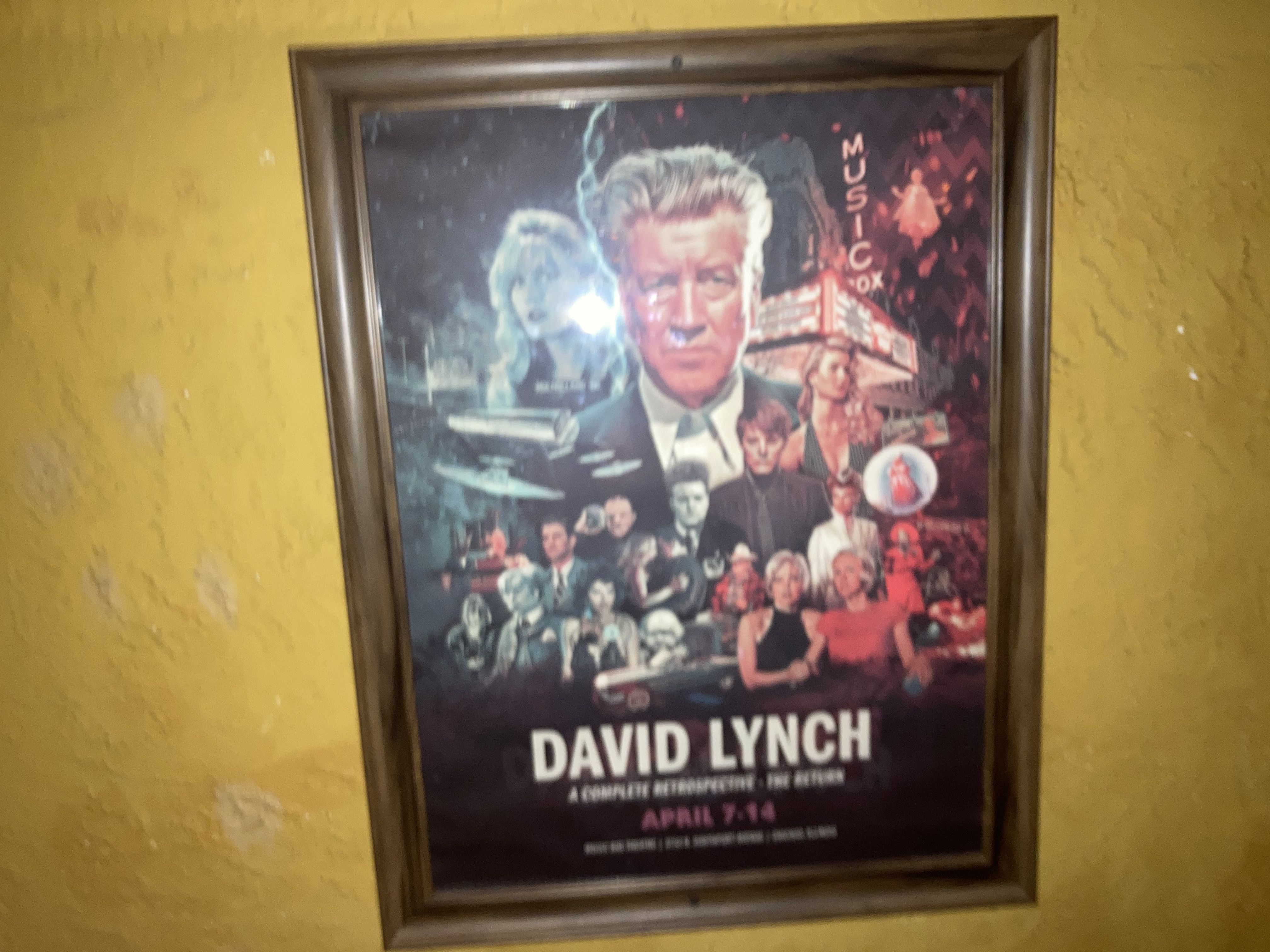
This poster was for a David Lynch Retrospective that was held from April 7-14 back in 2022.

-Click here to watch an incredible trailer for it.

I actually think this is one of the most beautiful homages to a fictional film and television character, which in this case is actress Sheryl Lee’s Laura Palmer from Twin Peaks. As one can see from the picture, it is a dollar donation jar. As my dear readers might have guessed, I am a huge fan of the films of director David Lynch, everything Twin Peaks related and Sheryl Lee. This picture was taken on July 21 of this year when I saw director Akira Kurosawa’s Seven Samurai in a 4K Restoration on the big-screen.

I also wanted a picture of me holding the aforementioned donation jar and I got my chance. As one can notice, I am very happy in this photo. To this day, along with Nicolas Roeg’s Don’t Look Now, David Lynch’s Twin Peaks: Fire Walk with Me ranks for myself as one of the most emotionally powerful horror films ever made. As the beautiful and tragic Laura Palmer in the latter, Sheryl Lee gave a performance for the ages. Palmer’s descent into madness in that film always moves me to tears. As viewers, we want to reach into the screen to rescue Laura and then console her. Any director who can incite those feelings into us (in this case, Lynch) is doing something right.
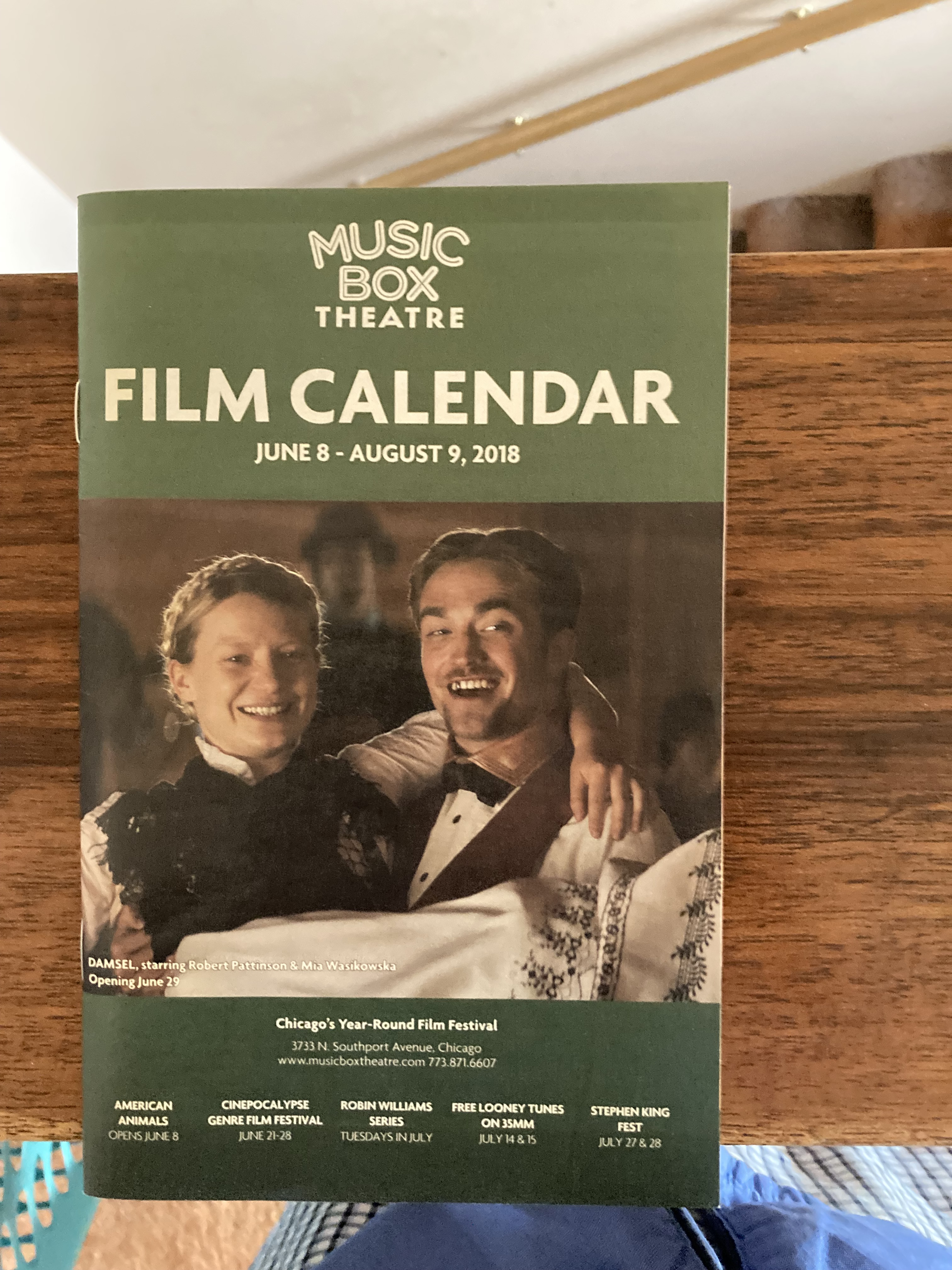
This photo was taken today, but this Film Calendar is from the Summer of 2018 as one can deduce from the picture. In October of that same year, I saw director John Carpenter’s 1982 masterpiece The Thing in 70 mm.

Once Again, this photo was today, but this CINEPOCALYPSE calendar was from the Summer of 2018. I saw director Stephen Hopkins tightly-paced Chicago set 1993 Neo-noir action thriller Judgment Night there. I took a picture with Hopkins that has unfortunately been lost to time due to the fact taken on my old IPhone 😦 I do not know If it is just me, but director Alex Cox’s 1984 Sci-fi/Neo-noir/comedy Repo Man would be perfect for that. I do not know If CINEPOCALYPSE is still annually there though.

Back in August of this year (in this case 2024), the Music Box Theatre got a spectacular renovation that included drink holders – I noticed this when I saw Vertigo in 70 mm two Sundays ago 🙂 Click here to read more about it.

-Click here to watch this clever trailer (or lack thereof) for it 🙂
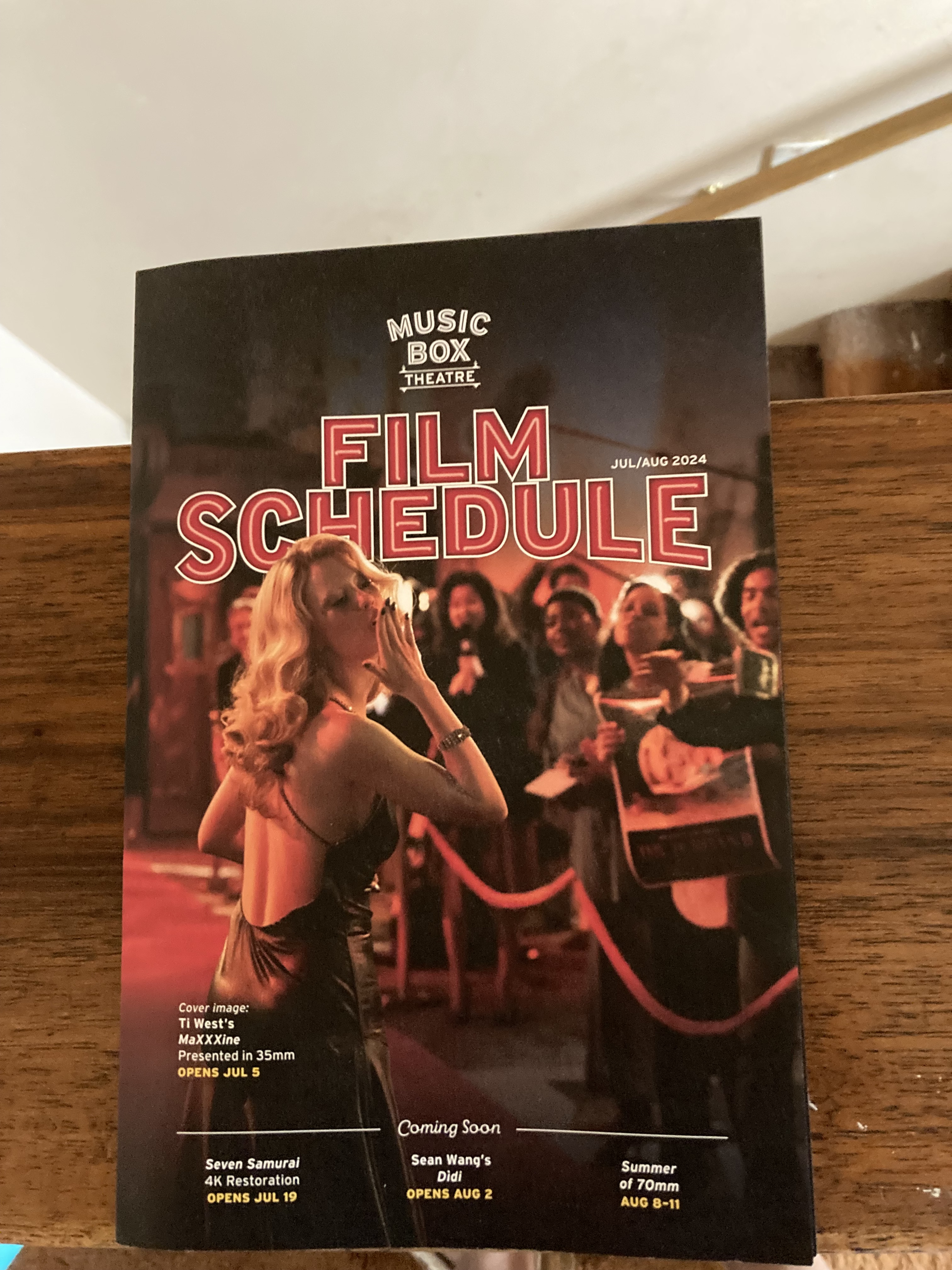
I picked up one of these Film Schedules back in July when I saw Seven Samurai there. I also saw the classic 1959 spy thriller North by Northwest (also directed by Hitchcock) in 70 mm back on August 11 of this year. That last title was part of their Summer of 70 mm series.

-Click here to watch the trailer for it.
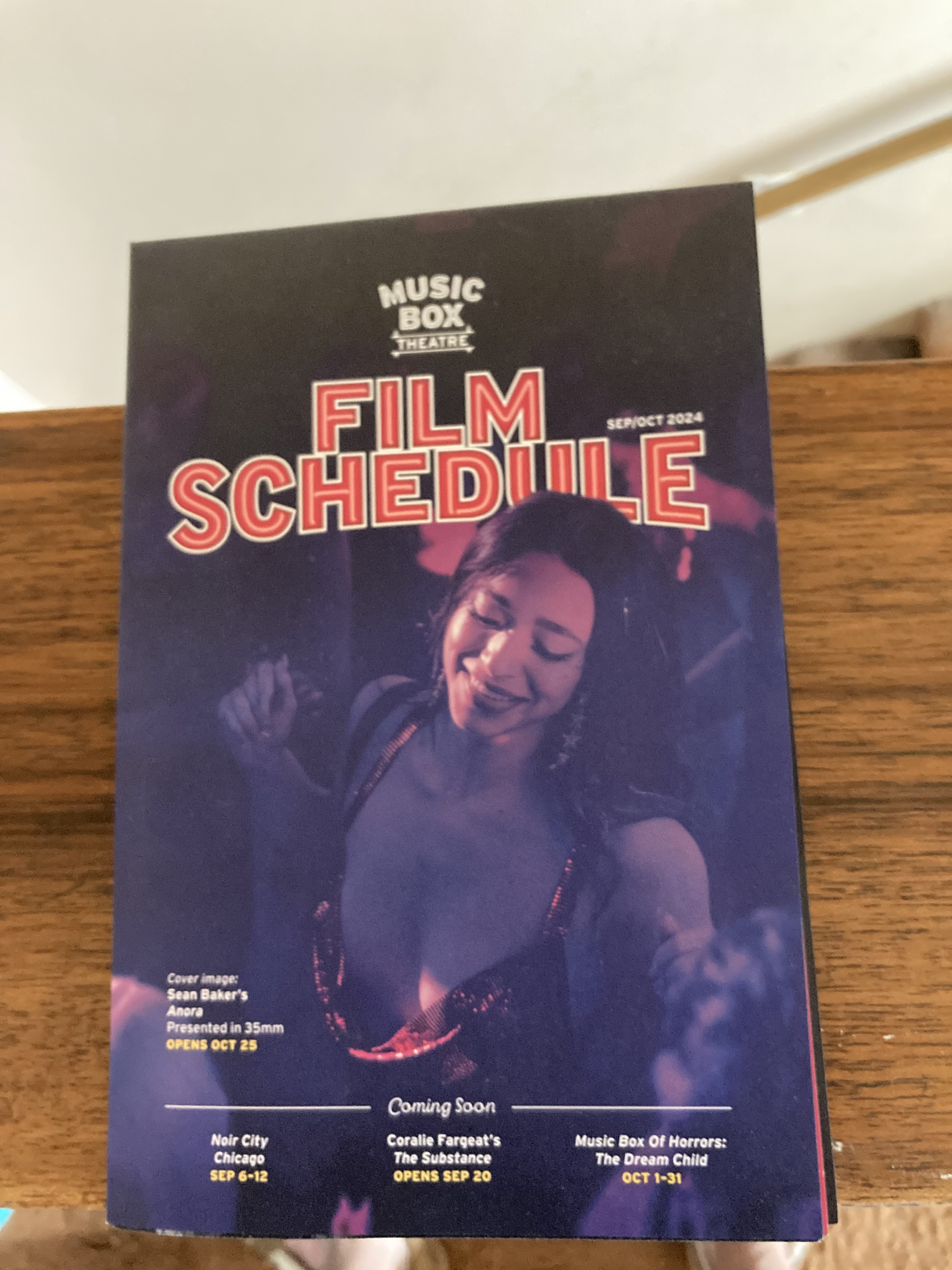
I picked up one of these Film Schedules when I saw Vertigo in 70 mm two Sundays ago.

-In Closing-

All in all, I want to thank Chicago’s Music Box Theatre for the wonderful time I had watching my number one favorite film of all-time (in this case Vertigo) on a big-screen in 70 mm. All of you keep up the great work as always 🙂

-If any of my dear readers are interested in more info, click here to watch an 11-minute video celebrating the 90th anniversary of the Music Box Theatre from the Summer of 2019.

-Further Reading-

Click here to read my 2022 blog entry regarding My Top 10 Favorite Films of All-Time

Click here to read my 2023 blog entry regarding My Top 10 Favorite Horror Films of All-Time

Click here to read my 2023 blog entry regarding My 100 Favorite Films (1-100)

Click here to read my 2024 blog entry entitled Vertigo (1958) – A Ten-Part Personal Essay Written By Me

Click here to read my 2024 blog entry wishing actress Sheryl Lee a Happy 57th Birthday

-Questions for My Dear Readers-

1.) Name one of your favorite films that you have watched on a big theater screen? (70 mm or otherwise)

2.) Describe the excitement in your own words what it was like watching it on a big theater screen. What was it like?

3.) What theater/theatre did you see it at?

4.) As a follow-up to question #3, was there anything in the theater/theatre lobby that interested you (i.e. poster or otherwise)?

John Charet’s Take On: The Thing (1982)

Warning: My review contains potential spoilers. If you have not seen the film than I advise you to not go ahead and read this blog entry.

Not too long after gaining cult status in 1974 with Dark Star and again in 1976 with Assault on Precinct 13, director John Carpenter would go on to achieve box-office success with Halloween in 1978, The Fog in 1980, and Escape from New York in 1981. Each and every one of them were backed by independent distributors. Unlike those last five titles, this one would receive backing from a major Hollywood studio. Distributed by Universal Pictures on a budget of $15 million dollars, The Thing would be Carpenter’s first official commercial effort and at the time, his most expensive film to date. Furthermore, it was also the second of Carpenter’s four collaborative efforts with star Kurt Russell, who began his partnership with him on New York. Anyway, the resulting film was a loose remake of The Thing from Another World, a 1951 science-fiction classic directed by Christian Nyby and (with unofficial confirmation) the legendary Howard Hawks. Both of them are based on John W. Campbell Jr.’s 1938 short story Who Goes There?, but unlike the 51 film, this one is in actuality, a more faithful adaptation of the source material. Either way, Carpenter’s version still ranks as my personal favorite of the two great versions. Though dismissed as both a critical and financial failure when it was theatrically released in 1982, The Thing has since gone on to be reevaluated and is now often considered (and deservedly so) to be one of (If not) the best sci-fi-horror films and remakes ever made. In addition to all of that, I am going to go one step further by summing it up as Carpenter’s crowning achievement as a filmmaker.

Winter has arrived for a group of twelve male researchers at Outpost 31, an American research base located in Antarctica. The unit primarily consists of R.J. Macready (Kurt Russell), a helicopter pilot, Blair (Wilford Brimley), a biologist, Copper (Richard Dysart), a doctor and Garry (Donald Moffat), a station commander. The others are Nauls (T.K. Carter), Palmer (David Clennon), Childs (Keith David), Norris (Charles Hallahan), Bennings (Peter Maloney), Clark (Richard Masur), Fuchs (Joel Polis) and Windows (Thomas Waites). After encountering a Norwegian man trying to shoot an Alaskan Malamute, the team intervenes and rescues the animal and right after accidentally shooting Bennings in the leg, that same guy is shot by Garry as an act of self-defense. At first, the sled dog comes off as harmless, but later on, it turns out that the mutt was not really human. In other words, it is revealed to be some kind of monstrous creature-like thing that had wiped out everyone at the Norwegian station. Even after one of the crew members burns it to death with a flamethrower, the thing still manages to survive.

The next day, all of the crew watch a videotape that was found amid the carnage and wreckage at the Norwegian base from the other day. The video shows that same group of Norwegian researchers thawing out a UFO that had been sitting in the ice and snow for over 100,000 years. The Norwegians ended up sealing their doom by unleashing the alien which led to the events from earlier. As to be expected, the thing starts hiding within the bodies of the individual Americans inevitably resulting in a deadly game of survival.

Director John Carpenter does for The Thing what William Friedkin did for Sorcerer five years earlier. Working with the biggest budget he had ever been given at the time, Carpenter treated his version of The Thing similarly to how Friedkin envisioned his even bigger budgeted ($22 million dollars) previously mentioned remake of The Wages of Fear, a 1953 French adventure thriller directed by the extraordinary Henri Georges Clouzot. In other words, he saw it as a labor of love. Based on what I have read from other sources, Carpenter and Friedkin were both heartbroken when their dream projects failed to win the hearts and minds of critics and audiences on their initial theatrical runs. Fortunately enough, The Thing and Sorcerer have since been reexamined by the two aforementioned groups to the point where they are now recognized as masterpieces of their own respective genres. Similar to how Friedkin used The French Connection and The Exorcist while making Sorcerer, Carpenter looked at his previous hits (the last three in particular) and carefully studied their strengths so he could expand upon them in exciting ways. In the case of The Thing, Carpenter takes the suspense of Halloween, the atmosphere of The Fog and the cynicism of Escape from New York and blends them all together into a whole. As Friedkin had proven with Sorcerer, Carpenter managed to equal and surpass not only his previous work with The Thing, but also his subsequent ones as well.

From start to finish, The Thing can be viewed as the cinematic equivalent of a genuinely scary haunted attraction that (fittingly) leaves one with a strong sense of dread. As the opening credits roll out, we are presented with master composer Ennio Morricone’s understated yet eerie background music that sets the tone for the entire film. Morricone’s brooding score coincides perfectly with the (appropriately) bleak and chilly atmosphere of Antarctica (the story’s setting), which is depicted here as a very secluded place. At the same time, director John Carpenter keeps us glued to the edges of our seats before knocking us all out of the ballpark with his thrilling jump scares. The build up to some of them can give off a feeling of mystery like the (implicitly) suspicious face of the dog in two scenes long before it is revealed that he/she is neither human nor animal, Norris refusing to stand guard and Blair calmly pleading to Macready to let him out of the shed. In that last one, we are all wondering why a noose is visually displayed in the background to the right side of him? Other times, Carpenter catches us by surprise in scenes relating to the attempted reviving of Norris and one during a blood sample sequence. Not to spoil anything, but the payoff to each and every one of these scenes (and many more) proves to be one of immense satisfaction.

As with An American Werewolf in London and The Howling from a year earlier, The Thing is often celebrated for its groundbreaking special make-up effects courtesy of Rob Bottin, who was responsible for the werewolf transformation sequences on that latter 1981 entry. In this one, Bottin satisfies and terrifies us to the fullest with all sorts of spectacularly gory effects that pop up frequently in between the first and last shot of the film. The standouts here include a dog mutating into an alien and killing two other dogs in the process, the arms of Copper being bitten off by the chest of Norris, whose body now belonged to the thing and that is just for starters. Once Copper meets his grisly demise, the head of Norris stretches off and begins to develop a pair of spider legs. Shortly after moving with them, the parasite gets obliterated to death by a flame thrower. Equally noteworthy is the previously mentioned blood sample scene where Palmer unexpectedly mutates into an alien and kills Windows by stuffing him halfway into its mouth and after spinning him around for a while, the creature spits out his mutilated body. Bottin puts his heart and soul into bringing these horrifying creations to vivid life and while he may have won a special Academy Award for the visual effects on Total Recall (another film that I adore) in 1991, his amazing work on The Thing still towers above all of his other accomplishments (at least for me) as the greatest one within his filmography.

Preceding Prince of Darkness by five years and In the Mouth of Madness by seven, The Thing served as the first in director John Carpenter’s self-titled “Apocalypse Trilogy” and in retrospect, it comes off as the most polished of the three classics. Like the two aforementioned succeeding entries, this one is reportedly influenced by the style and traits of horror author H.P. Lovecraft. If I were to pick just one literary trademark (read here) of his that debatably gets examined here, it would be that of “civilization under threat.” No doubt, the plot does center around a group of researchers battling an unidentified creature from outer space, but that is just the tip of the iceberg. As the story progresses, the alien proves to be capable of controlling a human by hiding within its body so it can shortly mutate and wreck havoc. Inevitably, each of the crew members end up accusing the other of not being what they seem. The late Bill Lancaster (son of deceased acting legend Burt Lancaster) wrote the screenplay (adapted from John W. Campbell Jr.’s original source) and Carpenter uses it to openly (or subtly) explore the element of paranoia, which (metaphorically speaking) serves as the film’s primary theme. Two separate pieces of dialogue (from Macready) sum this up perfectly: “Nobody… nobody trusts anybody now, and we’re all very tired” and “Trust is a tough thing to come by these days. Tell you what-why don’t you just trust in the Lord?” Some of the characters express feelings of insanity (e.g. Macready and Blair), resentment (e.g. Childs), annoyance (e.g. Garry) and hopelessness (e.g. Fuchs) among other emotions. Even an attempted act of betrayal is not out of the question (e.g. Clark). All of these sentiments were most certainly timeless 30 years ago and they are slightly ever more so now in 2017 in relation to our current socio/political climate. Regardless of where an individual gets their information (the internet, television, newspapers etc.), everybody (right, left or otherwise) seems to either hate or distrust another with a passion these days. Unlike Darkness and Madness, The Thing’s apocalyptic scenario really hits close to home in more ways than one and it may be the only one of the three that comes the closest to serving as something of a companion piece to They Live (another one that I love) from six years later (also directed by Carpenter). Unlike that 1988 sci-fi-horror entry though, Carpenter’s politically charged social commentary is presented here in a more subdued, but no less expressive manner.

Out of the three film adaptations of John W. Campbell Jr.’s 1938 short story Who Goes There?, this 1982 update stands out as the most definitive of the bunch. When it comes to pure cinematic horror, no monster movie has been as extremely terrifying on every single level imaginable as The Thing. Director John Carpenter has made plenty of excellent movies in his career, but out of all of them, I single out The Thing as the only one that can actually be defined as a bona fide all-around masterpiece. Along with Ridley Scott’s Blade Runner, The Thing can now, with hindsight, join Steven Spielberg’s E.T. the Extra Terrestrial as one of the three finest science-fiction films of both 1982 and all-time. Similar to William Friedkin’s Sorcerer from 1977 and Philip Kaufman’s 1978 version of Invasion of the Body Snatchers, The Thing is a superior remake of an already undisputed classic that can arguably be seen as one of the many truly great films of its decade, which in this case, would be the 1980’s.

-Star Rating-
* * * * (Out of * * * *)